




Travel can disrupt even a consistent training routine. Hotel rooms may be small, schedules may change, and access to equipment is never guaranteed. The good news is that a useful workout can be built from movements that require only your body, a little floor space, and careful progression. This guide explains the best bodyweight exercises for travelers no gym, with options for strength training, running support, yoga, cardio fitness, flexibility, injury prevention, and recovery.
What Are Bodyweight Exercises for Travelers?
Bodyweight exercises are movements in which your body provides most or all of the resistance. Examples include squats, push-ups, lunges, planks, mountain climbers, and single-leg balance drills. A travel bodyweight workout adapts these exercises to limited space and equipment-free conditions.
The goal is not to copy a fully equipped gym program perfectly. Instead, the goal is to maintain movement quality, preserve useful strength, support cardiovascular fitness, and reduce the effects of long periods of sitting or travel. You can make bodyweight exercises easier or harder by changing use, range of motion, tempo, repetitions, rest periods, and exercise selection.
How to Build a No-Gym Travel Workout
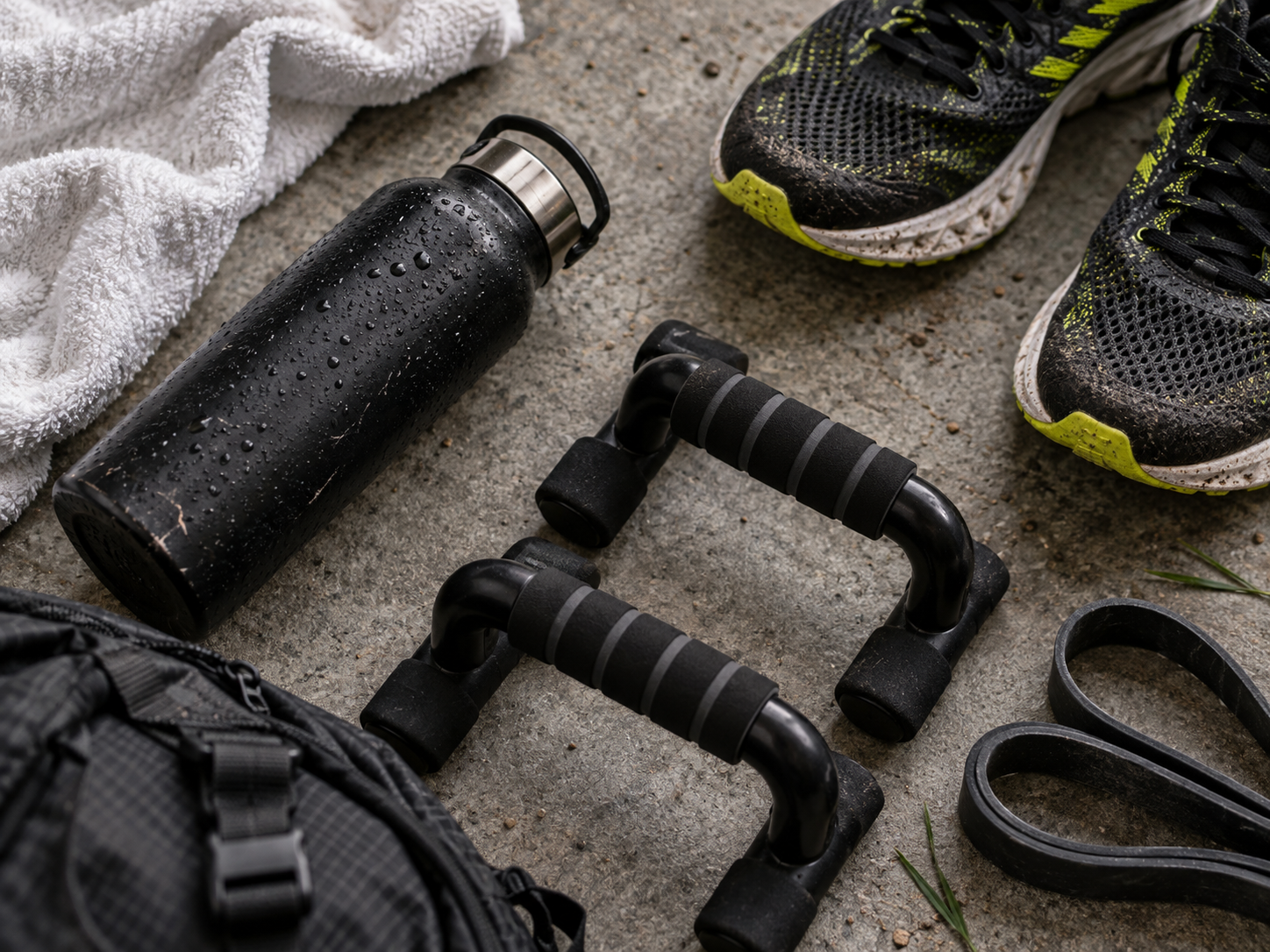
A balanced session usually includes five parts:
- Warm-up: Prepare joints, muscles, and breathing with controlled movement.
- Lower-body strength: Train squatting, stepping, and hip extension patterns.
- Upper-body and trunk strength: Use pushing movements and core exercises.
- Cardio or conditioning: Add brisk walking, running, stairs, or low-impact intervals.
- Cool-down and mobility: Reduce intensity and restore comfortable movement.
A simple session can take about 20 to 35 minutes, depending on the number of rounds and rest periods. Beginners should focus on controlled technique rather than completing as much work as possible. Experienced trainees can use slower lowering phases, pauses, unilateral exercises, or additional rounds to increase difficulty.
The Best Bodyweight Exercises for Travelers No Gym
1. Bodyweight Squat
The squat trains the thighs, hips, and trunk while reinforcing a movement pattern used in daily life. Stand with your feet around hip- to shoulder-width apart. Brace your midsection, bend your knees, and lower your hips as far as you can without losing balance or comfort. Keep your feet grounded and rise smoothly.
Start with two or three sets of 8 to 15 repetitions. To progress, use a slower descent, pause near the bottom, or perform a split squat. If your knees or hips feel uncomfortable, reduce the range of motion and check that your knees track in line with your feet.
2. Reverse Lunge
Reverse lunges challenge each leg separately and can help travelers maintain lower-body strength for walking, hiking, and running. From a standing position, step one foot backward, lower the rear knee toward the floor, and push through the front foot to return to standing. Hold a wall or stable surface if balance is limited.
Perform 6 to 12 repetitions per side. The reverse step is often easier to control than a forward lunge, but it still requires coordination. Keep the front heel connected to the floor and avoid dropping quickly into the bottom position.
3. Single-Leg Glute Bridge
This floor-based exercise trains the glutes and the muscles that extend the hip. Lie on your back with one foot on the floor and the other leg lifted or bent. Press through the planted foot, raise your hips, pause briefly, and lower with control. Keep your ribs from flaring and avoid arching the lower back to create extra height.
Use a two-leg glute bridge if the single-leg version is too difficult. Try 8 to 15 repetitions per side. The exercise is useful after long travel periods because it provides gentle hip extension without requiring equipment.
4. Push-Up
Push-ups train the chest, shoulders, arms, and trunk. Place your hands slightly wider than shoulder width, extend your legs, and keep your body in a straight line. Lower your chest under control and press away from the floor. Your elbows should not have to flare directly sideways.
For an easier variation, place your hands on a sturdy desk, counter, or wall. For a harder variation, slow the lowering phase or use a narrow hand position. Stop a set when your hips sag, your neck reaches forward, or your shoulder position becomes difficult to control.
5. Pike Push-Up
The pike push-up shifts more work toward the shoulders. Begin with your hands on the floor and hips raised into an inverted V shape. Bend your elbows and lower the top of your head toward the floor, then press back up. Keep the movement controlled and use a smaller range of motion if needed.
This is an optional progression for travelers who already perform regular push-ups comfortably. It is not essential, and people with shoulder pain should choose a more tolerable pressing variation or seek professional guidance.
6. Dead Bug
The dead bug trains trunk control while your arms and legs move. Lie on your back with your hips and knees bent. Brace gently, lower one arm and the opposite leg toward the floor, then return to the starting position before changing sides. Keep the lower back as still as you can without holding your breath.
Use a small range of motion if your back arches. Perform 6 to 12 controlled repetitions per side. Quality matters more than speed, making this a practical core exercise for a quiet hotel-room workout.
7. Side Plank
The side plank challenges the muscles along the side of the trunk and the shoulder supporting your body. Support yourself on one forearm or hand, stack or stagger your feet, and lift your hips. Keep your head, ribs, pelvis, and legs aligned.
Hold for a comfortable period rather than forcing a long duration. A bent-knee side plank is a useful beginner variation. If your shoulder or wrist becomes painful, stop and choose another trunk exercise.
8. Mountain Climber
Mountain climbers combine a plank position with alternating knee drives. They can raise breathing demand while training shoulder and trunk stability. Move slowly at first, keeping your hands under your shoulders and your pelvis as steady as possible.
For a lower-impact option, step one foot forward at a time instead of jumping. This is useful when noise, joint sensitivity, or limited space makes fast movements unsuitable.
9. Calf Raise
Calf raises support the lower-leg muscles used in walking, running, and stair climbing. Stand near a wall for balance, rise onto the balls of your feet, pause, and lower slowly. Work both legs together or progress to one leg at a time.
Use a comfortable range and avoid bouncing. Travelers who are increasing their running or walking volume should treat calf raises as supplementary strength work, not a substitute for gradual training progression.
10. Bear Crawl or Low-Impact March
A bear crawl can develop whole-body coordination, but it requires clear floor space and comfortable wrists. Move opposite hand and foot together while keeping your knees close to the floor. If crawling is impractical, use a standing march with deliberate arm movement.
The standing option is quieter and easier to perform in a small room. Both variations can be included in a conditioning circuit, but neither should be performed on a slippery surface.
A Practical 25-Minute Travel Workout
After a brief warm-up, complete the following circuit for two or three rounds. Rest as needed between exercises and take a longer break between rounds.
- Bodyweight squats: 10 to 15 repetitions
- Push-ups or incline push-ups: 6 to 12 repetitions
- Reverse lunges: 8 repetitions per side
- Single-leg or two-leg glute bridges: 8 to 12 repetitions per side, or 12 to 15 total
- Dead bugs: 6 to 10 repetitions per side
- Low-impact mountain climbers: 20 to 40 controlled alternating steps
Use a level of effort that leaves room for good technique. You do not need to train to complete exhaustion for the session to be useful. If you are returning after illness, a long break, or a demanding journey, begin with one round and assess how you feel later that day and the following morning.
Adding Running and Cardio Fitness
Bodyweight strength work and aerobic exercise support different qualities. A brisk walk, easy run, stair session, or short interval workout can complement a room-based routine. Travelers who already run should avoid suddenly adding intense sprints simply because they have extra time. A gradual return is more appropriate after flights, poor sleep, or several inactive days.
One simple option is a walk-run session: alternate comfortable jogging with walking, keeping the effort moderate. Another option is a low-impact indoor circuit using marching, step-ups on a stable low platform, and controlled bodyweight movements. The best choice depends on available space, footwear, weather, and your normal training background.
Mobility, Yoga, and Flexibility for Travelers
Long periods of sitting can make gentle mobility feel helpful, although stretching alone does not replace strength or aerobic training. After the main workout, try several slow movements:
- Cat-cow movements for comfortable spinal motion
- Half-kneeling hip-flexor mobility
- Child’s pose or a supported rest position
- Gentle thoracic rotation
- Standing calf and hamstring stretches
- Slow breathing with relaxed shoulder movement
Hold stretches at a mild to moderate sensation, not sharp pain. Yoga-based movement can also help you transition from travel to training, especially when breathing, balance, and controlled range of motion are emphasized.
Progression Without Equipment
When you cannot add weights, progression can come from several methods:
- use: Move from wall push-ups to incline push-ups and then floor push-ups.
- Unilateral loading: Progress from squats to split squats or single-leg variations.
- Tempo: Lower slowly and pause at the most demanding point.
- Range of motion: Increase the movement only when control is consistent.
- Density: Complete the same work with slightly less rest, without sacrificing form.
- Volume: Add a repetition, set, or training day gradually.
Record the variation, repetitions, and perceived effort in a notes app. This creates a simple training log and helps prevent random increases in workload. If performance drops because of jet lag or poor sleep, maintain an easier variation rather than forcing progression.
Nutrition and Recovery During Travel
Training is only one part of staying active on a trip. Regular meals, adequate fluids, and foods containing carbohydrates and protein can support energy and recovery. Practical choices include yogurt, eggs, beans, fish, lean meat, fruit, whole grains, nuts, and vegetables when available. There is no need for a special supplement to complete a bodyweight workout.
Sleep disruption can affect coordination, motivation, and perceived effort. On days after overnight travel, choose walking, mobility, or a shorter circuit if a demanding workout feels inappropriate. Light movement, gradual exposure to local daylight, and a consistent sleep routine may help you adjust, but individual responses vary.
Injury Prevention and Safety
Clear the floor, check that surfaces are not slippery, and use stable furniture only for support—not as an improvised exercise device unless it is designed to bear your weight. Wear footwear that suits the activity, particularly for running, jumping, or outdoor surfaces.
Warm up with easy movement and begin with a manageable variation. Joint discomfort, sharp pain, unusual swelling, chest pain, faintness, or severe shortness of breath are reasons to stop. Seek medical advice before exercising if you have a relevant medical condition, recent injury, or uncertainty about whether a movement is appropriate. This article is general educational information and is not a diagnosis or individualized medical plan.
Pros and Limitations of No-Gym Travel Workouts
Advantages
- They require little or no equipment and can be performed in many locations.
- They make it easier to maintain consistency during travel.
- They can train strength, coordination, mobility, and conditioning in one session.
- Exercise difficulty can be adjusted with variations, tempo, and range of motion.
- They can complement running, recreational sport, and outdoor activities.
Limitations
- Lower-body strength may eventually plateau without external resistance.
- Pulling exercises for the back are difficult to train safely without suitable equipment.
- Some movements are challenging for people with wrist, shoulder, knee, or back symptoms.
- Small-room workouts may not provide enough space for running or vigorous jumping.
- Bodyweight circuits do not automatically replace a structured sport-specific program.
Q&A
How often should I do a bodyweight workout while traveling?
Choose a frequency that fits your normal training and recovery. Two or three focused sessions during a trip can help maintain routine, while walking and mobility can fill the gaps. Avoid scheduling hard sessions on consecutive days if your muscles are unaccustomed to the exercises.
Can bodyweight exercises build strength without a gym?
Yes, especially for beginners and intermediate trainees. Challenging variations, unilateral movements, slower tempos, and full controlled ranges can provide meaningful resistance. However, advanced strength development may eventually require external load or specialized equipment.
What is the best exercise if I have very little space?
Squats, reverse lunges, glute bridges, push-ups, dead bugs, side planks, and marching require relatively little room. Select quiet, low-impact variations if you are above another room or sharing a small space.
Should I stretch before or after the workout?
Use dynamic, comfortable movement before training, such as marching, arm circles, and easy squats. Longer relaxed stretches are often more convenient after the workout or during a separate mobility session. Neither approach should cause pain.
Method and Sources
The exercise selection in this guide follows a movement-pattern approach: squat, lunge, hip extension, push, trunk stability, and conditioning. The general recommendations are consistent with the World Health Organization Guidelines on Physical Activity and Sedentary Behaviour and the American College of Sports Medicine’s ACSM’s Guidelines for Exercise Testing and Prescription, 11th edition. The Centers for Disease Control and Prevention also provides public guidance on physical activity and safety. These sources offer broad health and training principles; they do not establish a single best routine for every traveler.
Final Takeaway
The best bodyweight exercises for travelers no gym are the ones you can perform safely, consistently, and with enough control to progress. Combine a squat or lunge, a push, a hip exercise, a trunk drill, and a modest cardio component. Add walking, running, yoga-inspired mobility, sensible nutrition, and recovery practices according to your schedule. A flexible plan that respects sleep, travel fatigue, and your current fitness is more useful than an ambitious routine you cannot repeat.