







Strength training at home is exercise that challenges your muscles using body weight, household-safe equipment, or fitness equipment in your own living space. It can include movements such as squats, push-ups, rows, lunges, and hip hinges. The goal is to make muscles work against resistance, then gradually adjust the challenge as your ability changes. You do not need a gym or a complicated setup, but you do need exercises that suit your current fitness and a plan that allows for recovery.
This guide explains how home strength training works, how to begin, and how it can fit alongside running, yoga, and cardio fitness. It also covers its benefits and limitations, injury prevention, flexibility, recovery, and nutrition for athletes. The information is general: individual needs vary, and a clinician or qualified exercise professional can help with personal concerns.
What strength training at home means
Strength training, also called resistance training, is physical activity in which muscles produce force against a resistance. At home, that resistance might come from your body weight, resistance bands, dumbbells, a loaded backpack, or another stable piece of equipment intended for exercise. A movement can be made more demanding by changing its range of motion, tempo, use, resistance, or number of repetitions, as long as you can maintain control.
Strength training is not defined by having heavy weights or by trying to lift as much as possible. A beginner doing controlled sit-to-stands from a sturdy chair is training strength. So is an experienced exerciser using bands or dumbbells for a challenging set. The useful level of difficulty depends on the person, the exercise, and the training goal.
Public guidance from the U.S. Centers for Disease Control and Prevention (CDC) includes muscle-strengthening activity among its recommendations for adults. The American College of Sports Medicine (ACSM) publishes resistance-training guidance for healthy adults, emphasizing regular training of major muscle groups and adapting a program to individual goals and abilities. These organizations provide broad guidance, not a personalized prescription. People with health conditions, pain, or specific performance goals may need advice tailored to them.
Why include strength work in a home workout?

Resistance exercise can help develop muscular strength and endurance. Depending on the training plan, it can also support physical function, help maintain muscle, and make everyday tasks such as carrying groceries or getting up from a chair feel more manageable. Stronger muscles can be useful to runners and other athletes, but strength work is only one part of overall fitness.
A home routine can also reduce practical barriers. It may take less travel and can use little or no equipment. That flexibility can make it easier to fit short sessions into a busy week. Training at home can be private and convenient for people who prefer to exercise without a crowded facility.
Strength training does not replace aerobic activity. Running, brisk walking, cycling, and other cardio exercise challenge the cardiovascular system in ways a short strength session may not. Yoga can develop balance, mobility, and body awareness, depending on the style and class. These activities have different emphases and can complement one another rather than compete.
How to start a home strength routine
1. Check your space and equipment
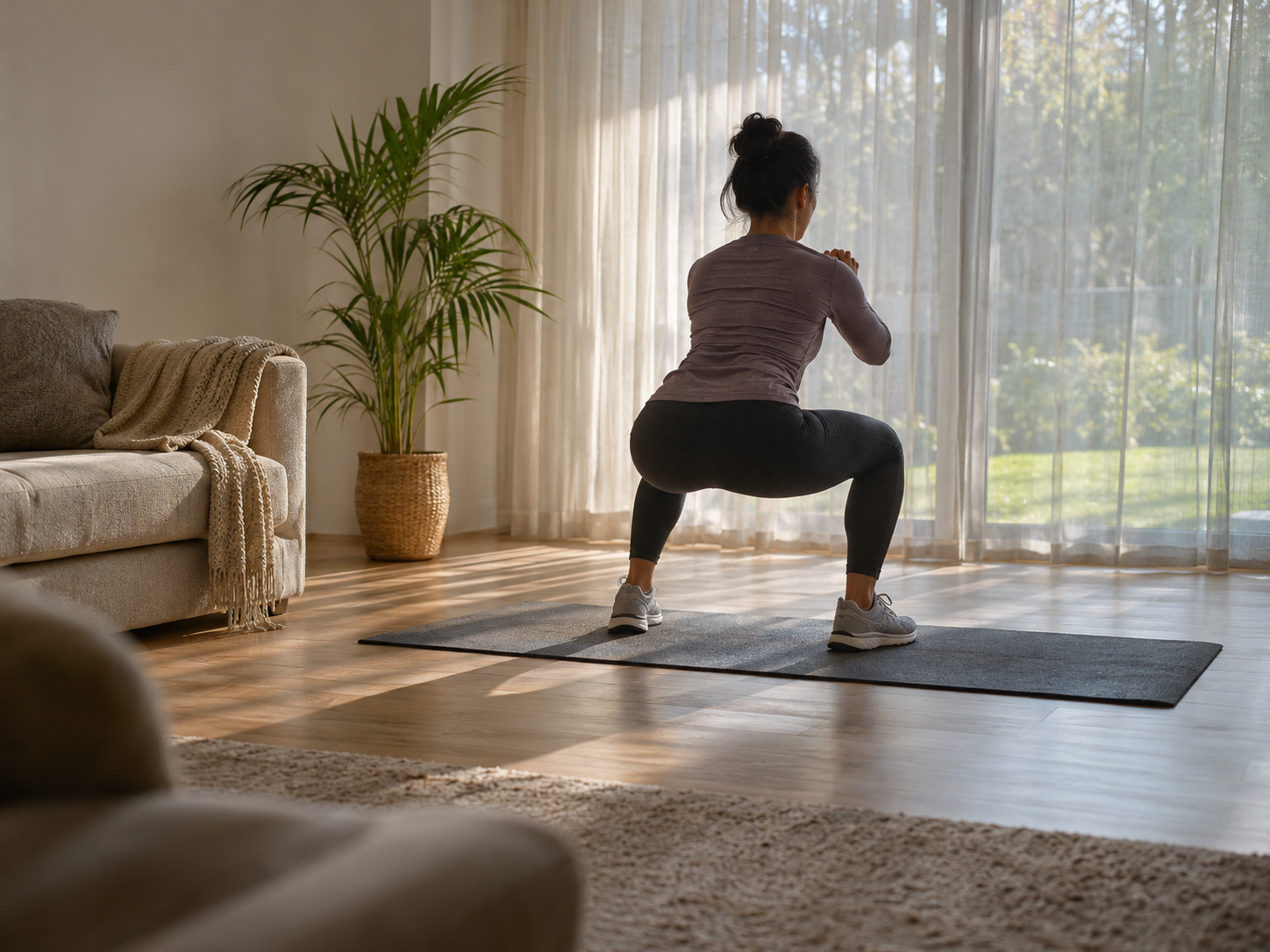
Choose a flat, uncluttered area with enough room to move in every direction. Check the floor for slipping hazards and keep pets, children, and breakable objects away while exercising. Use a stable chair or step only if it is designed or positioned securely for the movement. Do not use furniture, improvised anchors, or heavy objects if they can slide, tip, or break under load.
Body-weight exercises are sufficient for learning basic patterns. A resistance band or a pair of manageable weights can add options later. Inspect equipment for wear before use, follow its instructions, and avoid tying bands to doors or objects unless the product is designed for that use.
2. Learn a few movement patterns
A balanced beginner routine can include a knee-dominant movement, a hip hinge, a push, a pull, and a trunk-stability exercise. Examples include:
- Squat or sit-to-stand: Sit back toward a sturdy chair, then stand with control. Adjust the chair height or use hand support if needed.
- Hip hinge: Practice moving the hips back while keeping the torso controlled. A glute bridge is another beginner-friendly way to train the hips.
- Push: Try a wall push-up or an incline push-up against a stable surface. A lower incline generally makes the movement more demanding.
- Pull: Use a resistance band only with a secure, manufacturer-approved anchor, or choose a suitable dumbbell row if you have equipment and know how to perform it safely.
- Trunk stability: Try a short, controlled dead bug or a modified plank, stopping before your position breaks down.
These are examples, not a required list. A movement that causes pain, feels unstable, or cannot be performed with control should be changed or skipped. A qualified trainer or physical therapist can help select suitable alternatives.
3. Begin with a manageable dose
Start with a small number of exercises and sets that leave you able to complete repetitions with steady form. Rest between sets as needed. There is no universal starting number that suits everyone: recent activity, age, sleep, health, and exercise experience all matter. The first aim is to learn the movements and establish a routine, not to finish exhausted.
During a set, the final repetitions may feel challenging, but you should still be able to control the movement and breathe. Stop if you feel sharp pain, dizziness, unusual shortness of breath, or other concerning symptoms. Muscle effort is expected; pain is not a useful target.
4. Progress gradually
When an exercise feels controlled and consistently manageable, increase the challenge one step at a time. You might add a few repetitions, another set, a slightly stronger band, or a harder variation. Change only what you can continue to perform with good control. A heavier load is not automatically better, and increasing everything at once makes it harder to understand how your body is responding.
Keep a simple record of the exercise variation, sets, repetitions, and how it felt. This is useful for noticing gradual progress and for identifying when workload, fatigue, or discomfort is rising. There is no need to test a maximum lift to make a beginner program effective.
Sample beginner session
This example is a template, not a prescription. Pick variations that are comfortable and suitable for your ability. Move at a controlled pace and rest enough to maintain good form.
- Warm up with several minutes of easy movement, such as marching in place and gentle joint movements.
- Perform a sit-to-stand or comfortable squat.
- Perform a glute bridge or light hip hinge.
- Perform a wall or incline push-up.
- Perform a suitable pulling exercise, if you have a safe setup.
- Finish with a trunk-stability exercise that you can do without straining.
For the first sessions, one or two controlled sets of each selected movement may be enough. Repeat the session on nonconsecutive days if you recover comfortably. This is only a starting framework: health conditions, training history, and the demands of other activities may call for a different schedule.
Combining strength training with running, yoga, and cardio
Runners can use strength work to train muscles that support movement, but adding sessions increases total training load. Start with a modest amount and pay attention to how your legs feel during runs. If lifting leaves you persistently fatigued or changes your running form, reduce the workload or adjust session timing. Avoid placing an unfamiliar, demanding leg workout immediately before an important run or event.
Yoga may complement strength work through balance, mobility, and controlled movement. It is not a substitute for progressive resistance if your aim is to increase strength, and some yoga poses can be demanding in their own right. Choose a style and range of motion that fit your ability. For general cardio fitness, include aerobic movement that you can sustain and recover from; strength sessions need not be turned into nonstop circuits to be useful.
Flexibility and mobility are related but distinct. Flexibility describes how far a muscle can lengthen, while mobility includes the ability to move a joint through a range with control. A warm-up can prepare you for exercise, while gentle stretching may be part of a cool-down or separate mobility practice. Stretching should feel tolerable, not painful, and it does not guarantee injury prevention.
Recovery and nutrition for athletes
Adaptation takes place over time, not only during a workout. Sleep, rest days, sufficient food, hydration, and sensible increases in training all contribute to recovery. Mild muscle soreness can occur after unfamiliar exercise, but severe or worsening soreness is a reason to reduce the next session and reassess. Persistent pain, marked swelling, weakness, or symptoms that interfere with daily activity warrant medical advice.
For nutrition, a varied eating pattern that provides adequate energy, protein, carbohydrates, fats, and micronutrients supports training and general health. Needs differ with body size, activity, health, and goals. Hydration needs also depend on conditions and exercise. No specific supplement is required to start strength training, and claims of rapid or guaranteed results deserve caution. A registered dietitian, especially one experienced in sports nutrition, can offer individualized guidance.
Benefits and limitations
Potential benefits
- Training can be done with little or no equipment and adapted to different experience levels.
- Regular resistance exercise can build strength and muscular endurance over time.
- A home routine can be easier to schedule and can complement aerobic exercise and sport-specific practice.
- Recording exercises and progress can help make training more consistent and deliberate.
Limitations to consider
- Limited equipment can make it harder to increase resistance for some exercises, especially as strength improves.
- Without coaching or feedback, it can be difficult to identify technique errors or choose the right exercise variation.
- Small or cluttered spaces may restrict movement, and improvised equipment can create hazards.
- Home training may not fully prepare someone for the demands of a particular sport or replace specialized coaching and rehabilitation.
- Results vary. Exercise selection, consistency, recovery, nutrition, health, and starting ability all influence progress.
Injury prevention and safety
Reduce avoidable risk by choosing a clear area, using stable equipment, learning movements before adding resistance, and progressing gradually. Warm up with easy movement related to the session. Keep breathing rather than straining through every repetition, and stop a set when your form cannot be maintained. Training through pain, rushing repetitions, or attempting an unfamiliar maximum effort can undermine safety.
Exercise is not risk-free, and no routine can promise to prevent injury. If you have a chronic condition, are pregnant or recently postpartum, have had surgery, or are returning after an injury, ask a healthcare professional what activity is appropriate. Seek urgent care for severe or sudden symptoms such as chest pain, fainting, or serious difficulty breathing.
Sports psychology and consistency
Motivation can vary, so make the routine easy to start: choose a regular time, keep necessary equipment accessible, and set a goal based on completing the session rather than achieving a dramatic result. Focus on controllable actions, such as practicing a movement or logging a workout. If you miss a session, resume with the next planned opportunity instead of trying to compensate with an unusually hard workout. This measured approach can help keep training sustainable and reduce pressure to treat every session as a test.
Concise Q&A
Can I build strength without weights?
Yes. Body-weight movements can challenge muscles, especially when the exercise variation is appropriate. As you adapt, you may need a harder variation, more controlled repetitions, or safe added resistance.
How often should I train at home?
There is no single schedule for everyone. Allow time to recover between challenging sessions for the same muscles, and account for running, sport, sleep, and other demands. Public recommendations are broad population guidance, not an individualized training plan.
Do I need to feel sore for a workout to count?
No. Soreness is not a reliable measure of an effective session. Gradual improvements in control, repetitions, resistance, or everyday function are more useful signals.
Can strength training help my running?
It can complement running by developing strength, but it does not replace running practice or aerobic conditioning. Manage the combined workload and adjust if recovery or running quality declines.
Bottom line
Strength training at home means challenging your muscles against resistance in a space you can use safely. Start with controlled, manageable movements, cover several major movement patterns, and progress gradually. It can fit well alongside running, yoga, and cardio, but equipment, space, coaching, and individual health needs can limit what a home program can provide. Consistency, sensible recovery, and attention to symptoms matter more than making every workout intense.
Disclaimer: This article is for general informational purposes and is not medical advice or a substitute for individualized guidance. Consult a qualified healthcare professional before changing exercise if you have a health concern, injury, or symptoms.