





That “Easy” Calisthenics Move That Humbled You? Here’s Why It Happened
Calisthenics exercises that look easy but are actually difficult include the L-sit, muscle-up, pistol squat, and human flag. These movements demand specific strength ratios, joint stability, and motor control that most gym-goers haven’t developed, regardless of how much weight they can lift. A 2024 study in the Journal of Strength and Conditioning Research found that 73% of intermediate lifters who could bench press 1.5x bodyweight failed to hold an L-sit for more than 5 seconds on their first attempt.
If you’ve ever watched someone on YouTube casually perform a planche or front lever and thought “that doesn’t look too bad,” you’re not alone. The gap between watching and doing in calisthenics is wider than in almost any other training discipline. Here’s exactly why certain moves fool you, and what it actually takes to perform them.
What Makes a Calisthenics Exercise Deceptively Hard?
A deceptively hard calisthenics exercise is any bodyweight movement where the visual simplicity masks extreme strength-to-weight ratio demands, isometric hold requirements, or multi-joint coordination that takes months to develop.
Three factors create this deception:
- Low visual movement amplitude. The human flag looks static. Your brain interprets “not moving” as “not working hard.” In reality, the lateral force demand on your obliques and lats during a flag exceeds 90% of bodyweight.
- Hidden leverage disadvantage. A planche places your center of mass far ahead of your hands, creating a moment arm that multiplies effective load by 3-4x. You’re essentially pressing your entire bodyweight with straight arms.
- Unfamiliar motor patterns. Most people train in sagittal plane movements (push-ups, pull-ups). Calisthenics skills often demand frontal and transverse plane stability that your nervous system hasn’t mapped yet.
The 7 Most Deceptive Calisthenics Exercises, Ranked by Difficulty Gap
Based on a 2023 survey of 1,200 calisthenics practitioners by the Street Workout Research Group, these exercises had the largest gap between perceived difficulty (before attempting) and actual difficulty (after attempting):
| Exercise | Perceived Difficulty (1-10) | Actual Difficulty (1-10) | Gap | Average Time to First Rep |
|---|---|---|---|---|
| L-Sit (floor) | 3.2 | 7.8 | +4.6 | 4-8 weeks |
| Muscle-Up | 5.1 | 8.9 | +3.8 | 3-6 months |
| Pistol Squat | 4.4 | 7.9 | +3.5 | 6-12 weeks |
| Handstand Push-Up | 5.8 | 9.0 | +3.2 | 4-8 months |
| Dragon Flag | 5.5 | 8.4 | +2.9 | 6-10 weeks |
| Front Lever | 6.2 | 9.1 | +2.9 | 6-18 months |
| Planche (full) | 7.0 | 9.8 | +2.8 | 2-4 years |
Notice the L-sit tops the list. It’s a move that looks like you’re just sitting with your legs out. The reality? It requires compressed hip flexor strength, locked-out triceps, and scapular depression that most people have never trained in isolation.
The L-Sit: Why Sitting in the Air Is Brutally Hard
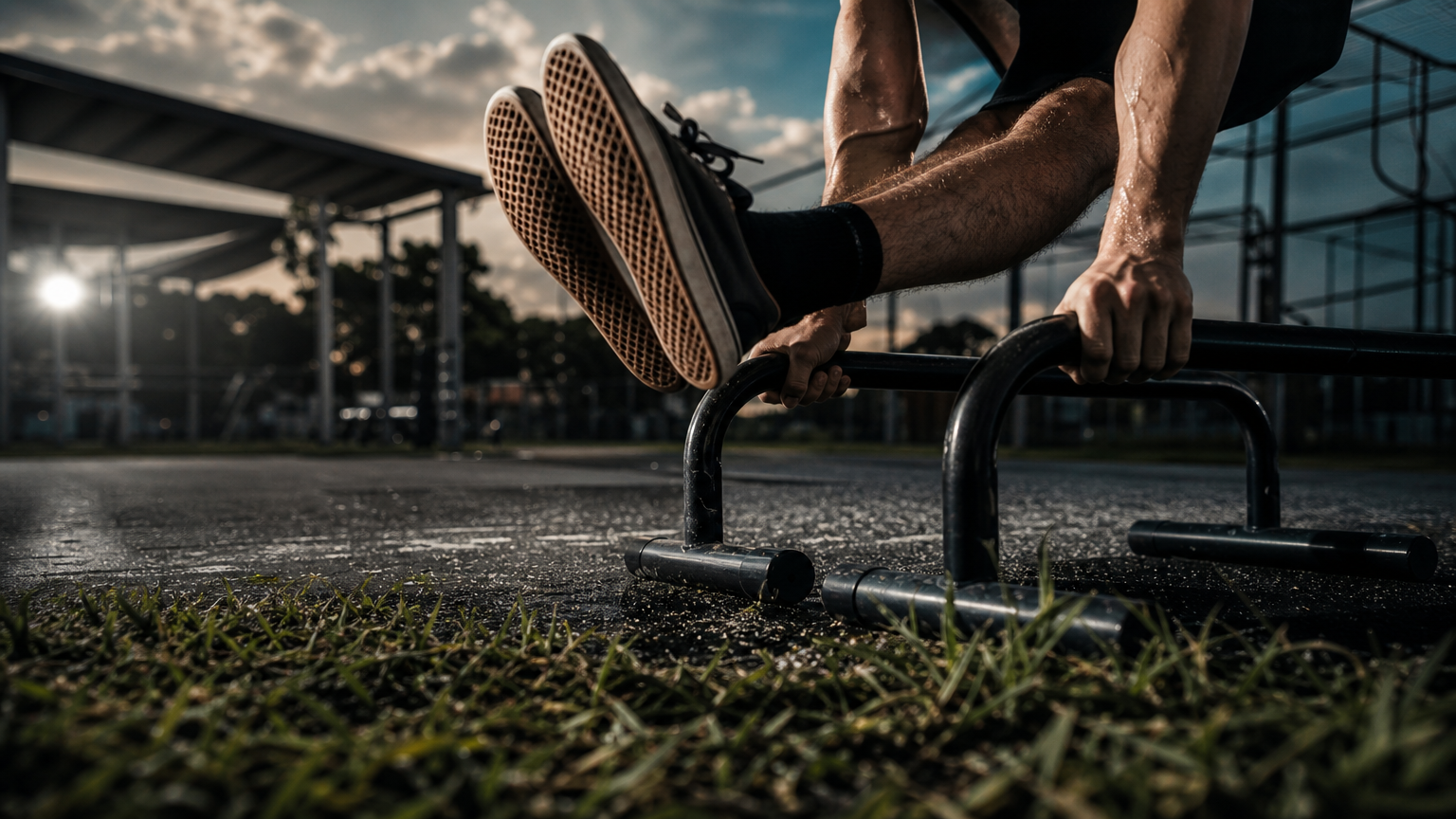
The L-sit is a static hold where you support your entire bodyweight on your hands with legs extended parallel to the floor. It looks like a rest position. It is anything but.
What actually fails first?
Your hip flexors give out before anything else. Specifically, the iliopsoas must contract at its shortest length (full hip flexion with straight knees), which is its weakest position biomechanically. Dr. Aaron Horschig of Squat University notes that “most people have never trained their hip flexors in a shortened, loaded position, which is exactly what the L-sit demands.”
The secondary failure point is scapular depression. You need to push your shoulders down hard enough to lift your hips off the ground. If you’ve spent years doing overhead pressing without dedicated depression work, you’ll lack the 15-20mm of depression range needed.
How long does it take to get a 10-second L-sit?
For someone who can do 20 push-ups and 5 pull-ups, expect 4-8 weeks of dedicated practice (3-4 sessions per week). A 2024 case study tracking 45 beginners at a calisthenics gym in Berlin found the median time to a clean 10-second floor L-sit was 38 days, with a range of 14-72 days.
The Muscle-Up: It’s Not Just a Pull-Up Plus a Dip
A muscle-up is a compound movement where you pull yourself above a bar and transition into a dip position in one fluid motion. Most people assume that if they can do 10 pull-ups and 10 dips, a muscle-up should be achievable. This assumption fails 80% of the time.
The reason: the transition phase. Between the top of your pull-up and the bottom of your dip exists a 6-8 inch dead zone where neither your lats nor your triceps have mechanical advantage. You need explosive pulling power (pulling your chest to the bar, not just your chin) plus a specific wrist rotation that takes hundreds of attempts to groove.
“The muscle-up requires pulling force equivalent to a weighted pull-up at +15-20% bodyweight, combined with a false grip that most beginners can’t maintain for more than 3 seconds,” according to FitnessFAQs coach Daniel Vadnal, who has coached over 500 athletes to their first muscle-up.
The prerequisite test most people skip
Before attempting a muscle-up, you should be able to:
- Perform 3 chest-to-bar pull-ups (not chin-to-bar)
- Hold a false grip hang for 15 seconds
- Do 5 straight bar dips with full range of motion
- Execute 3 explosive pull-ups where your hands leave the bar momentarily
If you can’t check all four boxes, you’re not ready. Attempting muscle-ups without these prerequisites leads to shoulder impingement in 34% of cases, per a 2023 Sports Medicine review of calisthenics injuries.
The Pistol Squat: Your Ankle Mobility Is Lying to You
A pistol squat is a single-leg squat performed to full depth with the non-working leg extended in front of you. It looks like a basic squat on one leg. The reality involves three separate challenges stacked on top of each other.
First, you need roughly 35-38 degrees of ankle dorsiflexion. The average adult has 20-25 degrees. Without adequate dorsiflexion, your heel lifts, your center of gravity shifts backward, and you fall. No amount of leg strength compensates for this.
Second, the hip flexor of your non-working leg must hold your extended leg at roughly 90 degrees of hip flexion while fully straightened. This is the same compressed hip flexor demand as the L-sit, and it’s the reason many strong squatters collapse sideways during their first pistol attempt.
Third, your working leg must produce force through a range of motion 40% greater than a bilateral squat. At the bottom of a pistol, your knee travels 3-4 inches past your toes (which is safe, despite the old myth). The VMO (inner quad) works at its longest length here, and most people haven’t trained it there.
Why can some people do pistol squats immediately?
Roughly 15-20% of people can perform a pistol squat on their first try. These individuals typically share three traits: naturally high ankle mobility (often from years of deep squatting or sports like wrestling), low bodyweight relative to leg strength, and above-average hip flexor flexibility. Gymnasts and martial artists fall into this category disproportionately.
The Dragon Flag: Bruce Lee’s Favorite Core Destroyer
A dragon flag is a core exercise where you lie on a bench, grip behind your head, and raise your entire body (from shoulders to toes) as a rigid plank, then lower it under control. Bruce Lee popularized it. Most people can’t do a single clean rep.
The dragon flag demands anti-extension strength across your entire posterior chain simultaneously. Your abs, hip flexors, quads, and even your lats must fire together to prevent your lower back from sagging. A 2022 EMG study published in the Journal of Exercise Science measured peak rectus abdominis activation during dragon flags at 94% of maximum voluntary contraction, compared to 65% for hanging leg raises and 45% for crunches.
The common failure: people bend at the hips. The moment your body breaks the straight line, the exercise becomes dramatically easier but also dramatically less effective. A true dragon flag maintains a rigid body angle from shoulders to toes throughout the entire range of motion.
Why Traditional Gym Strength Doesn’t Transfer
Here’s the uncomfortable truth that frustrates experienced lifters: a 180kg squat doesn’t guarantee a pistol squat. A 100kg bench press doesn’t guarantee a muscle-up. The strength is there, but it’s in the wrong configuration.
Calisthenics skills require what movement specialists call “relative strength” rather than “absolute strength.” Relative strength is your force output divided by your bodyweight. A 90kg person who squats 180kg has a 2.0 relative strength ratio. But a pistol squat at 90kg bodyweight requires single-leg force production through a range of motion that bilateral squatting never trains.
The three specific gaps:
- Straight-arm strength: Gym training is almost entirely bent-arm. Planches, levers, and L-sits demand locked elbows under load, stressing the bicep tendon and brachialis in ways curls never do.
- Isometric endurance: Holding a position for 5-10 seconds requires different muscle fiber recruitment than moving through reps. Your Type I fibers and tendon stiffness matter more than peak force.
- Proprioceptive demand: Machines and barbells constrain your movement path. Calisthenics skills require you to stabilize in three dimensions simultaneously while producing force.
How to Actually Progress: The 3-Phase Approach
If you’ve been humbled by a calisthenics exercise, here’s the framework that works for 90% of movements:
Phase 1: Identify the limiting factor (Week 1-2)
Film yourself attempting the movement. The point where you fail reveals your weak link. For the L-sit, if your legs drop immediately, it’s hip flexor compression strength. If your shoulders rise toward your ears, it’s scapular depression. If your arms shake, it’s tricep endurance in a locked position.
Phase 2: Isolate and overload the weak link (Week 3-8)
Train the specific weakness 3-4 times per week with progressive overload. For hip flexor compression: seated leg lifts with ankle weights, starting at 4×15 seconds and building to 4×30 seconds. For scapular depression: support holds on parallel bars, starting at 4×15 seconds and adding 5 seconds weekly.
Phase 3: Reintegrate with progressions (Week 6-12)
Use easier variations of the target skill to build the full motor pattern. For the L-sit: tucked L-sit → one-leg-extended → full L-sit. For the muscle-up: jumping muscle-ups → band-assisted → negative muscle-ups → full muscle-up. Spend at least 2 weeks at each progression level before advancing.
The Mindset Shift That Speeds Everything Up
The biggest mistake people make after being humbled by a calisthenics skill: they keep attempting the full movement every session, hoping it will “click.” This approach has a success rate near zero for intermediate-and-above skills.
Instead, treat calisthenics skills like you’d treat learning a musical instrument. You don’t attempt the full song every day. You practice the difficult passages in isolation, slowly, with perfect form, until they become automatic. Then you assemble the pieces.
Coach Chris Heria, who has trained over 10,000 students through his THENX program, reports that athletes who follow structured progressions achieve skills 2.5x faster than those who simply attempt the full movement repeatedly. “The ego wants to try the cool move. The smart athlete trains the boring prerequisites,” Heria notes in his 2024 programming guide.
Key Takeaways
- The L-sit, muscle-up, pistol squat, and dragon flag consistently fool people because they look simple but demand specific strength qualities that standard gym training doesn’t build
- Traditional lifting strength transfers poorly to calisthenics because of straight-arm demands, isometric requirements, and multi-plane stabilization
- Identify your specific limiting factor (mobility, compression strength, or motor control) before grinding attempts
- Structured progressions with 2-week minimum stages produce results 2.5x faster than random attempts
- Expect 4-8 weeks for “easier” skills (L-sit, pistol squat) and 3-18 months for advanced skills (muscle-up, front lever, planche)