







The best ankle strengthening exercises for trail runners are single-leg calf raises, tibialis raises, banded inversion and eversion, single-leg balance reaches, step-downs, hops, and loaded carries. Trail running injury reviews published in 2024 report lower-limb injury prevalence from 12.3% to 100%, with injury incidence ranging from 2.2 to 65 injuries per 1,000 running hours. Because the ankle is stressed on uneven ground, a 15-minute strength plan done 3 times per week is a smart target for runners who want fewer rolled ankles and better downhill control.
Why Ankles Matter More on Trails Than Roads
Road running asks the ankle to repeat a narrow pattern thousands of times. Trail running asks for fast decisions on rocks, roots, mud, camber, loose gravel, and steep descents. That extra demand is why ankle training must build strength, balance, stiffness, and reaction speed, not just calf size.
A 2024 systematic review by Jiang, Sárosi, and Bíró in Physical Activity and Health analyzed 24 trail-running injury studies with 17,664 runners. The authors found that the knee was the most reported injured region, followed by the ankle and Achilles tendon. They also reported injury incidence from 2.2 to 65 per 1,000 running hours.
Quotable fact: “A 2024 review of 17,664 trail runners found lower-limb injury prevalence ranged from 12.3% to 100%, with injuries occurring at 2.2 to 65 per 1,000 running hours.”
What Is Ankle Strength for Trail Running?
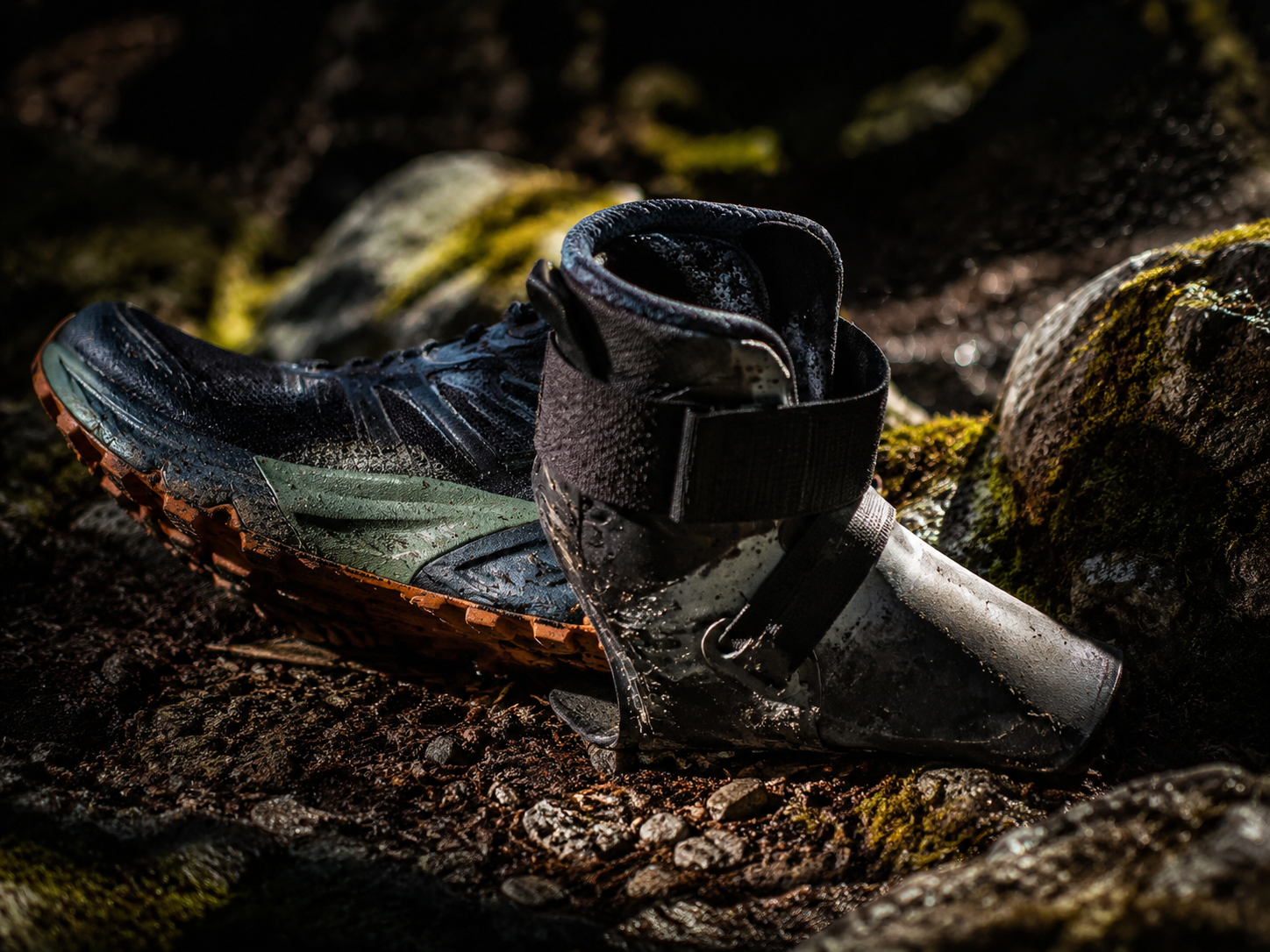
Ankle strength for trail running is the ability of the calf, shin, foot, and side-ankle muscles to control landing, push-off, and side-to-side motion on uneven terrain. It includes plantar flexion, dorsiflexion, inversion, eversion, balance, and fast corrective reactions after a poor foot strike.
In coaching terms, a trail-ready ankle has three jobs. It must absorb force when the foot lands below the body. It must hold shape when the ground tilts. It must push you forward without collapsing inward or outward.
The 7 Best Ankle Strengthening Exercises for Trail Runners
Use these exercises as a 15 to 20 minute circuit after an easy run or on a strength day. Start with 2 rounds for the first 2 weeks, then move to 3 rounds if your ankles feel good the next morning. Pain above 3 out of 10, swelling, or a limp means stop and get assessed by a clinician.
1. Single-Leg Calf Raise
The single-leg calf raise builds the gastrocnemius and soleus, the muscles that handle climbing, braking, and push-off. Stand on one foot near a wall, rise for 1 second, pause at the top, then lower for 3 seconds. Aim for 3 sets of 8 to 15 reps per side.
A useful benchmark is 25 controlled reps on each leg with the same height from rep 1 to rep 25. If you can do only 8 on your left and 18 on your right, your trail stride has a hidden asymmetry.
2. Bent-Knee Soleus Raise
The soleus works hard when the knee is bent, which happens on climbs, switchbacks, and technical descents. Sit with your knees at about 90 degrees, place a dumbbell or backpack on one thigh, and lift the heel slowly. Do 3 sets of 12 to 20 reps per side.
This drill is often the missing piece for runners who feel fine on flat roads but lose control on downhill trails. Use a 2-second lift and 3-second lower rather than bouncing.
3. Tibialis Raise
The tibialis anterior, the muscle along the front of the shin, controls foot slap and helps clear the toes over rocks. Stand with your back against a wall, heels 8 to 12 inches from the wall, and lift your toes toward your shins. Perform 2 to 3 sets of 15 to 25 reps.
Trail runners who trip late in long runs often need more dorsiflexion endurance. A simple field test is 30 tibialis raises without cramping or losing height. If your toes barely lift after rep 15, train this twice per week for 6 weeks before adding faster downhill work.
4. Banded Inversion and Eversion
These two band drills train the side-ankle muscles that resist rolling. For eversion, anchor a light band inside the working foot and move the forefoot outward. For inversion, anchor the band outside the working foot and move the forefoot inward. Do 2 sets of 15 to 20 reps each direction.
Quotable fact: “A 2024 systematic review in Sports Health reported that ankle injury prevention programs reduced ankle injury incidence with a pooled incidence rate ratio of 0.74, equal to a 26% lower rate.”
5. Single-Leg Balance Reach
This drill connects ankle strength to hip control. Stand on one foot and reach the free foot forward, sideways, and backward like a clock. Touch the floor lightly, then return to center. Complete 3 rounds of 5 reaches in each direction per leg.
6. Slow Step-Down
A step-down teaches the ankle, knee, and hip to share braking force. Stand on a 6 to 8 inch step, lower the opposite heel toward the floor for 3 seconds, tap lightly, then stand back up. Do 3 sets of 6 to 10 reps per side.
7. Low Pogo Hops
Pogo hops train ankle stiffness and quick ground contact. Keep the knees soft, hop 1 to 2 inches off the ground, and land quietly on the balls of the feet. Start with 3 sets of 15 seconds, then build to 3 sets of 30 seconds.
Comparison Table: Which Exercise Solves Which Trail Problem?
| Exercise | Main Target | Trail Problem It Helps | Starter Dose |
|---|---|---|---|
| Single-leg calf raise | Calf strength | Weak push-off on climbs | 3 x 8 to 15 each side |
| Bent-knee soleus raise | Soleus endurance | Downhill fatigue | 3 x 12 to 20 each side |
| Tibialis raise | Shin endurance | Toe catches and foot slap | 2 x 15 to 25 |
| Banded eversion | Peroneal muscles | Rolling outward on rocks | 2 x 15 to 20 |
| Balance reach | Proprioception | Late reaction to uneven ground | 3 x 5 reaches each direction |
| Step-down | Braking control | Unstable descents | 3 x 6 to 10 each side |
| Pogo hop | Ankle stiffness | Slow, heavy foot contacts | 3 x 15 seconds |
What Is Proprioception?
Proprioception is your body’s ability to sense joint position and movement without looking. For trail runners, ankle proprioception helps the foot correct quickly when it lands on a sloped rock, loose dirt, or root-covered surface.
After an ankle sprain, proprioception can stay impaired even when pain disappears. A BMJ Open protocol on chronic ankle instability notes that up to 70% of people who sustain lateral ankle sprains may develop chronic ankle instability when rehab is incomplete. That is why the best ankle strengthening exercises for trail runners include balance and reaction drills, not just resistance work.
Quotable fact: “BMJ Open reported in 2021 that up to 70% of people with lateral ankle sprains may develop chronic ankle instability, especially when early rehab is incomplete.”
Q&A: How Often Should Trail Runners Train Ankles?
How many days per week should I do ankle strengthening?
Most trail runners should do ankle strengthening 2 to 3 days per week for 8 weeks, then maintain with 1 to 2 days per week. Use the higher end if you run technical trails, have a previous ankle sprain, or are building toward a race with long descents.
An 8-Week Ankle Plan for Trail Runners
This plan uses the best ankle strengthening exercises for trail runners in a simple progression. It works best when paired with a steady running build of no more than 5% to 10% more weekly volume for most recreational runners.
- Weeks 1 to 2: Single-leg calf raise, tibialis raise, banded eversion, and balance reach. Do 2 rounds, 2 days per week.
- Weeks 3 to 4: Add bent-knee soleus raises and slow step-downs. Do 2 to 3 rounds, 3 days per week.
- Weeks 5 to 6: Add low pogo hops after strength drills. Keep hops short and quiet. Do 3 rounds, 2 to 3 days per week.
- Weeks 7 to 8: Move one balance drill outdoors onto grass or firm dirt. Keep one session indoors for clean strength work.
Unique coaching note: do not test your ankles on the same surface every week. Trails are variable, so your training should include one controlled surface and one natural surface. The controlled session builds measurable strength. The natural session teaches the foot to apply that strength when the ground is imperfect.
What Is Chronic Ankle Instability?
Chronic ankle instability is repeated giving way, weakness, or poor control after one or more ankle sprains. It can include pain, swelling, reduced range of motion, balance problems, and recurrent sprains during sport or daily activity.
A 2024 meta-analysis in Systematic Reviews included 9 randomized controlled trials with 341 patients and found balance training improved chronic ankle instability scores versus blank controls. The reported mean difference was 3.95 points with a 95% confidence interval from 3.26 to 4.64. For runners, that supports a practical rule: balance work is not optional after a sprain.
How to Know Your Ankles Are Ready for Technical Trails
Before returning to steep or rocky routes, check these five markers. You should pass them on both sides with less than a 10% difference between legs.
- 20 single-leg calf raises with full height and no bouncing.
- 30 tibialis raises without shin cramping.
- 30 seconds of single-leg balance with eyes forward.
- 10 slow step-downs from an 8 inch step with the knee tracking straight.
- 3 sets of 20 seconds of quiet pogo hops with even rhythm.
Common Mistakes That Keep Ankles Weak
The first mistake is doing every drill barefoot on unstable equipment. Barefoot work can be useful, but trail races happen in shoes, often when you are tired. Split your work: one clean barefoot or sock session for foot awareness, and one shoe-wearing session for trail transfer.
The second mistake is skipping slow lowering. Eccentric control matters because downhill running is braking repeated hundreds of times. Use 3-second lowers on calf raises and step-downs for at least the first 4 weeks.
Bottom Line
The best ankle strengthening exercises for trail runners combine calf strength, shin endurance, side-ankle control, balance, braking skill, and light hopping. Start with single-leg calf raises, tibialis raises, banded inversion and eversion, balance reaches, step-downs, and low pogo hops. Train them 2 to 3 times per week for 8 weeks, track side-to-side differences, and progress from controlled floors to firm natural surfaces.