







Training for a Spartan obstacle course race means preparing for more than a fast run or a strong set of pull-ups. You need to cover the distance over varied terrain, manage obstacles with different movement demands, and keep making good decisions when tired. A useful plan combines running, strength training, grip work, mobility, recovery, and sensible nutrition. The right balance depends on your current fitness, race distance, terrain, and experience.
This guide explains how to train for an obstacle course race Spartan-style, including practical workouts and ways to adapt them. It is general fitness information, not an individualized training prescription. Follow the current race rules and obstacle details published by Spartan, since event formats and requirements can vary.
What does Spartan race training involve?
Obstacle course race (OCR) training prepares a participant to run over uneven ground and complete physical challenges during the same event. Spartan races can include obstacles involving carries, climbing, crawling, balance, and grip. The exact obstacles, course layout, and distance depend on the event. That means preparation should cover broad capabilities rather than rely on practicing one specific obstacle.
For most recreational participants, the core is a combination of aerobic conditioning and full-body strength. Running supports movement between obstacles. Strength helps with lifting, carrying, climbing, and controlling your body. Grip endurance matters when an obstacle requires hanging or holding an object. Mobility, balance, and sound pacing help you move efficiently and avoid turning early fatigue into poor decisions.
Start with your race and your current fitness
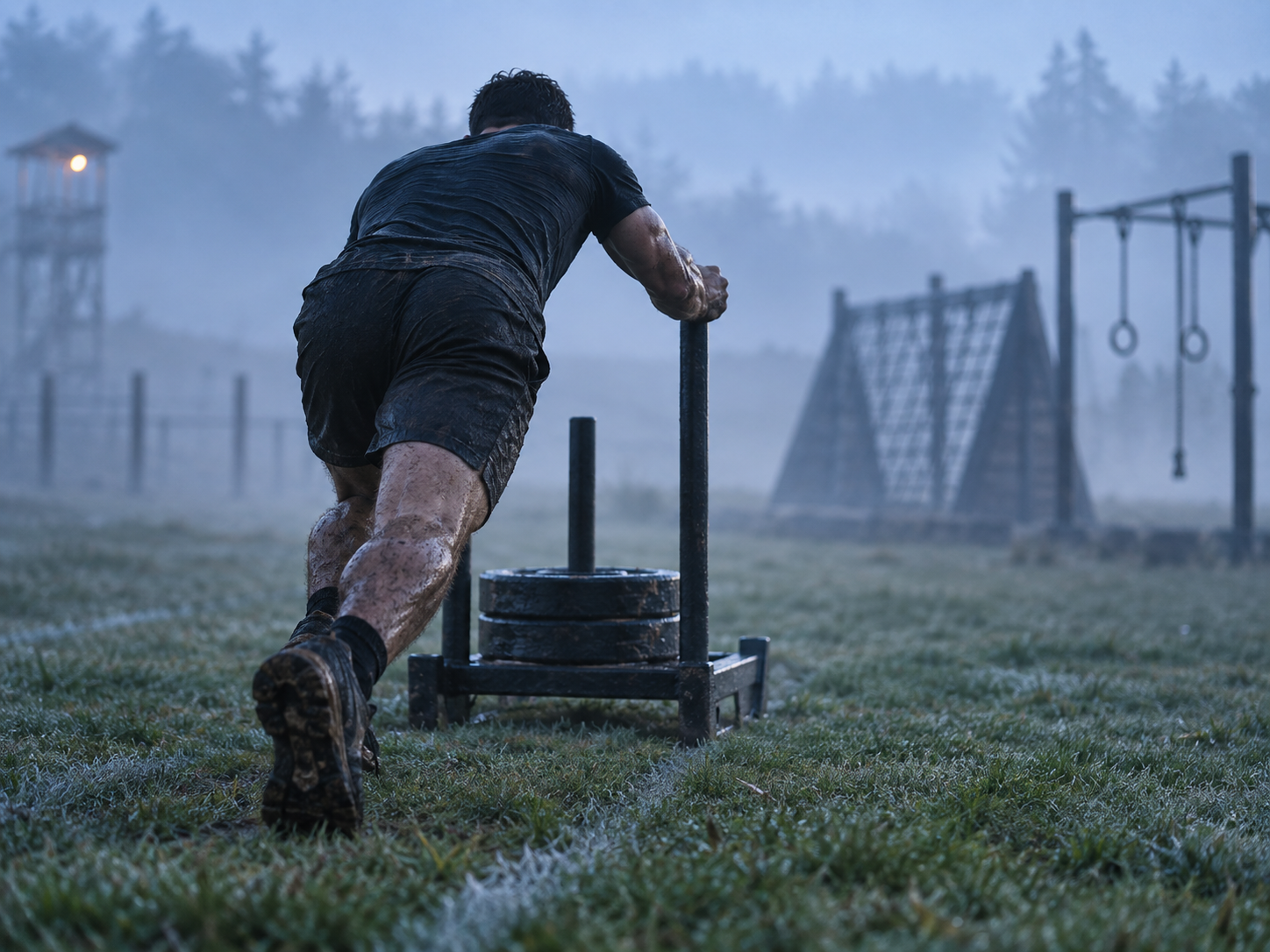
Before writing a schedule, identify the event distance, terrain, elevation, and any published race-specific rules. Check the organizer’s current information rather than assuming that every Spartan event is the same. Then take an honest look at your recent training: how often you run, whether you can comfortably complete an easy run, what strength exercises you already know, and whether you have any current pain or restrictions.
A first-time racer with little running experience should generally build a comfortable running habit before adding demanding obstacle simulations. Someone who already runs regularly but has little strength training may need more time for basic lifting and grip work. Avoid adding several new hard workouts at once. A gradual increase gives you a chance to notice how your body responds and adjust before fatigue accumulates.
Build a balanced weekly training routine
A weekly plan can include two or three runs, two strength sessions, and one or two shorter mobility or recovery sessions. These are flexible examples, not requirements. Beginners may need fewer sessions, while experienced athletes may tolerate more. Keep at least one day for rest or truly easy activity, and avoid placing every demanding workout on consecutive days.
Running: develop an aerobic base and terrain confidence
Use mostly easy running to build the ability to cover the event distance without racing every workout. An easy run should allow conversation in short sentences. If continuous running is currently difficult, use planned run-walk intervals and lengthen the running portions gradually. Increase only one major challenge at a time, such as duration, hills, or speed.
Once a steady base is established, add a modest hill session or short intervals on a safe, familiar route. Hills develop the ability to handle changes in grade, but they also place more demand on the legs than flat running. Keep hard sessions controlled, warm up first, and avoid sprinting downhill, where speed and uneven footing can increase fall risk. Include occasional trail or uneven-surface running only if the route is appropriate for your ability and conditions.
Strength training: prioritize useful movement patterns
Two full-body sessions per week can cover the basic patterns relevant to OCR: squatting, hinging, pushing, pulling, carrying, and bracing the trunk. Examples include goblet squats, hip hinges, step-ups, rows, push-ups, split squats, farmer carries, and controlled trunk exercises. Choose variations you can perform with stable technique. Start with a manageable load and leave room to recover rather than training every set to failure.
For obstacle preparation, include pulling and carrying movements, but do not assume that an exhausting circuit is automatically more race-specific. A strong foundation is often more useful than practicing rushed, sloppy repetitions. If you have access to appropriate equipment and coaching, you can gradually practice safe hangs, rope technique, or obstacle-like movements. Never improvise a high climbing or hanging setup that could fail or leave you stranded.
Grip and carries: train gradually
Grip can be challenged with farmer carries, towel-grip rows, dead hangs, or other exercises suited to your equipment and ability. Begin with short, controlled efforts. Stop if you feel sharp pain, numbness, or unusual tingling. Grip work can tire the hands and forearms quickly, so keep it modest at first and avoid scheduling a demanding grip session immediately before a key run or strength workout.
Carrying a load while walking is a practical way to build trunk and hand strength. Start with a light, stable load on level ground. Maintain an upright posture and a steady gait rather than leaning or rushing. Increase the load or duration gradually, not both at once. If carrying aggravates an existing back, shoulder, or joint problem, replace it with a suitable alternative and seek professional advice when needed.
Use race-style combinations without overdoing them
As your general fitness improves, some workouts can combine a run segment with a strength task. For example, run easily for a short period, complete a controlled set of step-ups or carries, then resume running. The goal is to practice transitioning between activities while maintaining good movement, not to imitate race exhaustion in every session.
Keep these sessions less frequent than your basic easy runs and strength work. Choose familiar exercises and a safe location. A home workout might combine brisk stair walking, bodyweight squats, incline push-ups, and a light carry using a secure household object. Do not use unstable furniture, slippery flooring, or improvised overhead rigs. If technique deteriorates, end the set or reduce the difficulty.
Mobility, yoga, and injury prevention
Flexibility and mobility can help you access comfortable positions for running, lifting, and stepping over obstacles, but stretching alone does not guarantee injury prevention. Include a brief dynamic warm-up before harder sessions: easy movement, leg swings within a comfortable range, gentle lunges, and a few gradual increases in running pace. After training, gentle stretching or yoga may help you relax and explore comfortable ranges of motion.
Yoga can be useful as a low-impact way to practice balance, breathing, and mobility. Select a class or routine suited to your experience, and avoid forcing deep positions, especially when cold or fatigued. Training should also account for sleep, rest days, footwear that suits the terrain, and gradual workload changes. Pay attention to persistent pain, worsening soreness, unusual shortness of breath, or declining performance. These can be reasons to reduce training and consult a qualified health professional.
Nutrition and hydration for training
Regular meals that include carbohydrate-rich foods, protein sources, and a variety of fruits and vegetables can support general training needs. Carbohydrates contribute energy for running and harder workouts; protein supports repair and adaptation. Needs vary with body size, training volume, health, and dietary preferences, so a single meal plan or exact intake target will not suit everyone.
Before a longer session, choose foods you already tolerate and allow enough time for digestion. For a race, practice your approach during training rather than trying unfamiliar products on event day. Drink according to thirst and conditions, and take heat and event duration into account. Both too little and excessive fluid intake can be harmful. People with medical conditions, a history of disordered eating, or specific dietary requirements should seek guidance from an appropriate clinician or registered dietitian.
Recovery techniques that support consistency
Recovery is part of training, not a reward for completing it. Schedule easy days, sleep as consistently as practical, and eat enough to support your activity. Gentle walking, easy cycling, or relaxed mobility can be useful when you want to move without adding another hard session. Foam rolling or massage may feel helpful to some people, but neither should be treated as a substitute for rest or as a guaranteed way to prevent injury.
If tiredness builds over several days, reduce training rather than forcing the planned workout. You can shorten a run, lower the load, remove a hard interval session, or take a rest day. A training plan is a tool for adaptation; it should change when your health, schedule, or recovery needs change.
Race preparation and pacing
In the final weeks before an event, avoid trying to make up for missed training with a sudden spike in volume. Keep familiar workouts, practice your event-day clothing and footwear where appropriate, and check the organizer’s instructions. If you expect mud, hills, or weather exposure, prepare for those conditions safely in training, but do not take unnecessary risks simply to recreate the course.
On race day, start at a pace you can sustain. Obstacles can interrupt running, and waiting or regrouping may affect your rhythm. Take a moment to understand an obstacle before beginning, follow staff directions, and use an alternative or skip an obstacle if you are injured, unwell, or unable to attempt it safely. Be considerate of other participants, particularly on narrow or crowded sections.
Pros and cons of obstacle-course-focused training
Potential benefits
- Variety: Running, strength work, carries, and balance challenges can make training engaging for people who prefer varied sessions.
- Broad fitness: A balanced approach can develop cardiovascular endurance alongside strength and grip capacity.
- Transferable skills: Practicing pacing, movement control, and switching tasks can be useful beyond race day.
Limitations and trade-offs
- More moving parts: Combining running, lifting, and obstacle practice requires planning so hard sessions do not crowd out recovery.
- Equipment or access: Some obstacles require facilities or supervision that may not be available at home.
- No guaranteed result: Training cannot remove all risk or ensure a particular finishing time. Course conditions, health, weather, and race logistics matter.
- Not ideal for every goal: Someone focused solely on distance running or maximal strength may need a more specialized plan.
Sources and training approach
This article uses a general training approach: build aerobic capacity and basic strength, progress gradually, and practice relevant skills safely. For event-specific details, consult Spartan’s official race information and rules for the particular event. For general exercise guidance, the American College of Sports Medicine (ACSM) publishes resources on exercise programming and physical activity. These sources inform broad recommendations; this article does not claim that a particular workout guarantees race performance or prevents injury.
Q&A
Can I train for a Spartan race at home?
Yes. You can build a base with walking or running, bodyweight squats, step-ups on a stable surface, push-ups, rows with suitable equipment, and loaded carries. Some obstacles require specialized equipment or supervised practice, so home training cannot reproduce every race challenge.
How many days a week should I train?
There is no universal number. Your starting fitness, race distance, schedule, and recovery all matter. Begin with a workload you can sustain, include rest or easy days, and add sessions only when you are recovering well.
Do I need to run the full race distance in training?
Not necessarily. Preparation depends on your experience and event. Many recreational racers build endurance through consistent easy running rather than repeatedly running the entire event distance. Ask a qualified coach for individualized planning if you are unsure.
Is yoga enough to improve flexibility for obstacles?
Yoga may support mobility and balance, but it does not replace running, strength, or obstacle-specific skill practice. Use comfortable ranges of motion and choose a routine that matches your experience.
Bottom line
To train for an obstacle course race Spartan-style, build a foundation with easy running and full-body strength, then add gradual hill, grip, carry, and race-style practice. Include mobility and recovery, fuel sensibly, and adapt the plan to your starting point. Consistency and safe progression are more useful than attempting to make every workout a race simulation.
Safety disclaimer: This article is for general informational purposes and is not medical advice. Exercise carries risk. Consult a qualified healthcare professional before starting or changing a training program if you have a medical condition, injury, concerning symptoms, or uncertainty about what is safe for you.