







A battle ropes workout routine for fat burning at home can add vigorous cardio and strength-endurance work to a small-space training plan. The ropes create repeated resistance as you produce waves, slams, circles, or alternating movements. Your heart rate can rise quickly, while your shoulders, arms, trunk, hips, and legs work to maintain posture and control.
Battle ropes do not have a special ability to remove body fat, and no exercise can reduce fat from one selected area. Fat loss is influenced by overall energy balance, regular physical activity, nutrition, sleep, stress, and individual health factors. Ropes are useful because they make high-effort intervals convenient, measurable by time, and adaptable to many fitness levels.
What Is a Battle Ropes Workout?
A battle ropes workout uses one or two thick ropes anchored to a stable point. You hold the free ends and create movement by repeatedly moving your arms and coordinating your legs and trunk. Common exercises include alternating waves, double-arm waves, rope slams, circles, and side-to-side patterns.
The rope itself does not move your arms for you. Each wave requires force production, repeated acceleration, and control as the rope travels toward the anchor. The farther you stand from the anchor, the more rope you typically have to move. A shorter distance, lighter rope, slower rhythm, or shorter work interval makes the exercise more manageable.
For fat-loss goals, battle ropes are best treated as one part of a complete program. Strength training helps maintain or build muscle, running can develop aerobic capacity, yoga and mobility work can support movement quality, and adequate nutrition and recovery determine how consistently you can train.
Equipment and Home Setup
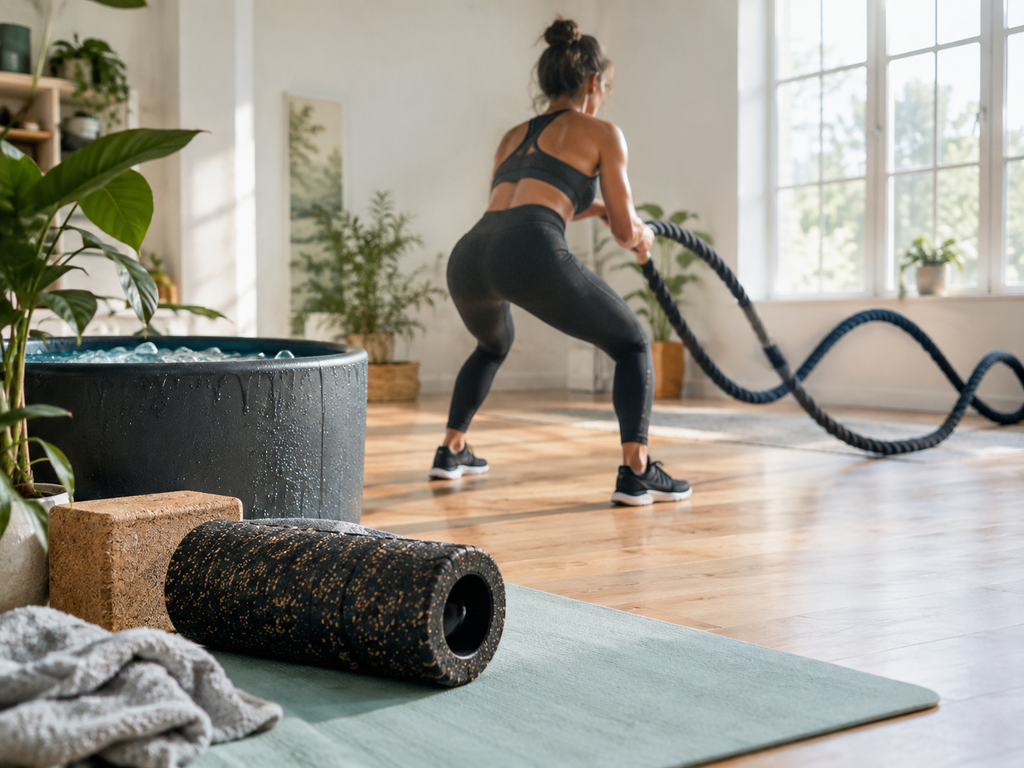
Choose a rope that matches your space and experience. Longer or thicker ropes can feel heavier and demand more force, but a lighter rope is often easier to control while you learn technique. The anchor must be fixed to a structural point that will not shift, loosen, or damage the wall, post, or door.
- Clear enough space for the rope to move without striking furniture, walls, pets, or other people.
- Use a level, non-slip surface that allows you to brace through your feet.
- Inspect the rope, anchor, handles, and attachment point before each session.
- Keep the rope away from sharp edges and moisture that could weaken its material.
- Wear shoes with reliable traction, especially for slams and lateral movements.
If a secure anchor is not available, do not improvise with a loose piece of furniture or an untested door attachment. A shorter rope or a resistance-band alternative may be more appropriate for your home setup.
25-Minute Battle Ropes Routine for Fat Burning
This routine is designed for a healthy adult who can perform moderate-to-vigorous exercise without medical restriction. Adjust the work periods, choose a lower-impact variation, or stop when technique breaks down. The goal is repeatable effort rather than maximum intensity on every interval.
1. Warm up for five minutes
Begin with two minutes of easy marching, walking, or light jogging in place. Then complete one round of the following movements:
- Eight controlled bodyweight squats
- Six reverse lunges per side, using a shallow range if needed
- Eight hip hinges with a neutral spine
- Ten shoulder circles in each direction
- Twenty seconds of easy rope waves
The warm-up should raise body temperature gradually and rehearse the positions needed for the main session. It should not leave you tired before the intervals begin.
2. Learn the base position
Stand with feet about hip-width apart, knees slightly bent, and ribs stacked over the pelvis. Hold the handles securely without squeezing so hard that your forearms fatigue immediately. Hinge slightly at the hips and keep your spine long. Begin with small, smooth arm movements, then gradually increase the size of the waves.
Keep your shoulders away from your ears and avoid leaning backward to create momentum. Your legs and trunk should help stabilize the movement, while the arms guide the rope. If your lower back starts taking over, reduce the wave size or rest.
3. Complete the interval circuit
Perform the five exercises below for 20 seconds of work followed by 40 seconds of easy recovery. Complete three rounds. During recovery, walk slowly, breathe steadily, and prepare for the next movement.
- Alternating waves: Move one arm up as the other moves down. Keep the waves regular and moderate in size.
- Squat with alternating waves: Maintain the waves while performing shallow squats. Keep your knees aligned with your feet and use a range you can control.
- Double-arm waves: Move both arms together. Reduce the amplitude if your shoulders or lower back begin to compensate.
- Rope slams: Raise the handles only as high as you can control, then drive them toward the floor using your hips and arms. Do not forcefully bend your spine.
- Alternating reverse-lunge waves: Step one foot back at a time while continuing small waves. Hold a split stance or remove the lunges if balance is limited.
Finish with three minutes of easy walking and relaxed breathing. The session can be shortened by completing two rounds or made easier by working for 15 seconds and resting for 45 seconds. Progress by adding a round, extending work slightly, reducing rest modestly, or standing farther from the anchor. Change only one variable at a time.
How to Make the Routine Effective for Fat Loss
Fat loss does not require every workout to feel extreme. Consistency, manageable training stress, and a nutrition pattern that supports a sustainable energy deficit matter more than chasing exhaustion. Use the rope routine as a conditioning session two or three times per week, leaving recovery time between hard sessions.
Combine it with strength training that covers pushing, pulling, squatting, hinging, carrying, and trunk control. If you have dumbbells, kettlebells, or resistance bands, a full-body session on separate days can complement the ropes. If running is already part of your routine, alternate easy aerobic runs with rope intervals rather than turning every day into a hard workout.
Nutrition for athletes and recreational exercisers should provide enough protein, carbohydrate, fluids, and micronutrients to support training. A meal or snack containing carbohydrate and protein can be useful around demanding sessions, but the best choices depend on personal preference, total intake, and digestive tolerance. Avoid treating one food, supplement, or post-workout product as a substitute for a balanced eating pattern.
Technique and Injury Prevention
Battle ropes can stress the shoulders, elbows, wrists, lower back, and knees when volume rises faster than your capacity. Injury prevention begins with conservative progression and repeatable technique.
- Keep the first sessions short enough that you can maintain posture throughout.
- Use smaller waves when your shoulders fatigue instead of forcing larger movements.
- Brace gently through the trunk without holding your breath for long periods.
- Pivot through the feet and hips for rotational patterns rather than twisting only through the lower back.
- Stop for sharp pain, unusual joint instability, chest pain, faintness, or severe shortness of breath.
- Allow sore muscles to recover before repeating a demanding rope session.
Mobility work can support comfortable positions, but stretching cannot correct every technical or training-load problem. A short yoga session, gentle hip and thoracic mobility, or relaxed breathing practice may fit well on an easier recovery day. Flexibility should improve movement options without causing pain or forcing joints beyond comfortable control.
Benefits and Limitations
Potential benefits
- Efficient conditioning: Short intervals can challenge the cardiovascular system without requiring a long workout.
- Simple intensity control: You can change rope amplitude, stance, distance, work time, and rest time.
- Whole-body coordination: Many patterns involve the legs, trunk, shoulders, and arms together.
- Home convenience: Once the rope is securely installed, sessions require little additional equipment.
- Training variety: Waves and slams can complement running, cycling, strength training, or bodyweight work.
Limitations
- Ropes do not replace progressive strength training for building maximal strength or increasing bone-loading variety.
- They may be unsuitable for a small or shared space because the rope can strike objects or people.
- High-intensity intervals can aggravate existing shoulder, elbow, wrist, back, or knee problems.
- They are not a direct measurement of calories burned or fat lost.
- Repeatedly training to exhaustion can reduce technique quality and interfere with running or strength recovery.
Use perceived effort and technique as practical guides. A challenging interval should still allow you to identify when posture, breathing, or coordination has deteriorated. Sports psychology principles such as setting a process goal, recording completed sessions, and using a realistic schedule can improve adherence more reliably than relying on motivation alone.
Comparison Methodology and Sources
The recommendations in this article compare battle ropes with other training methods by considering their primary role: ropes are mainly a conditioning and muscular-endurance tool, running is primarily locomotor aerobic or interval training, and strength training is organized around progressively challenging resistance. This is a practical comparison, not a claim that battle ropes produce a superior fat-loss result.
The training structure is informed by the Physical Activity Guidelines for Americans, 2nd edition, published by the U.S. Department of Health and Human Services, and the American College of Sports Medicine’s ACSM’s Guidelines for Exercise Testing and Prescription. Strength-training considerations are also consistent with the National Strength and Conditioning Association’s Essentials of Strength Training and Conditioning. These named sources provide broad guidance on physical activity, exercise screening, conditioning, progression, and resistance training; they do not establish that a particular rope routine will produce a specific amount of fat loss.
Concise Q&A
How often should I do battle ropes for fat loss?
Start with two sessions per week on nonconsecutive days. Add a third session only when you recover well and your technique remains consistent. Keep at least one easier day between demanding conditioning sessions.
Can beginners use battle ropes?
Yes, if the anchor is secure and the intervals are scaled. Begin with small waves, short work periods, longer rests, and no jumping or deep squatting. A qualified trainer can help if you are unsure about setup or technique.
Are battle ropes better than running?
Neither is universally better. Running is useful for people who enjoy locomotor endurance and have access to a suitable route or treadmill. Ropes are convenient for short, space-efficient intervals and add upper-body involvement. Choose the option you can perform safely and consistently.
Can ropes replace strength training?
Usually not. Ropes can improve muscular endurance, but a balanced strength program should include controlled resistance exercises that progressively challenge major movement patterns.
What should I do after a rope workout?
Cool down with easy movement, drink according to thirst and conditions, and eat normally. Prioritize sleep and allow tired muscles to recover. Gentle mobility or yoga may be appropriate if it feels restorative rather than strenuous.
Safety Disclaimer
This article is for general information and is not medical advice. Consult a qualified healthcare professional before starting vigorous exercise if you have a cardiovascular, respiratory, metabolic, neurological, musculoskeletal, or other health condition, are pregnant, take medication that affects exercise response, or have been inactive and are unsure how to begin. Stop exercise and seek urgent medical care for chest pain, fainting, severe breathing difficulty, or other serious symptoms.