






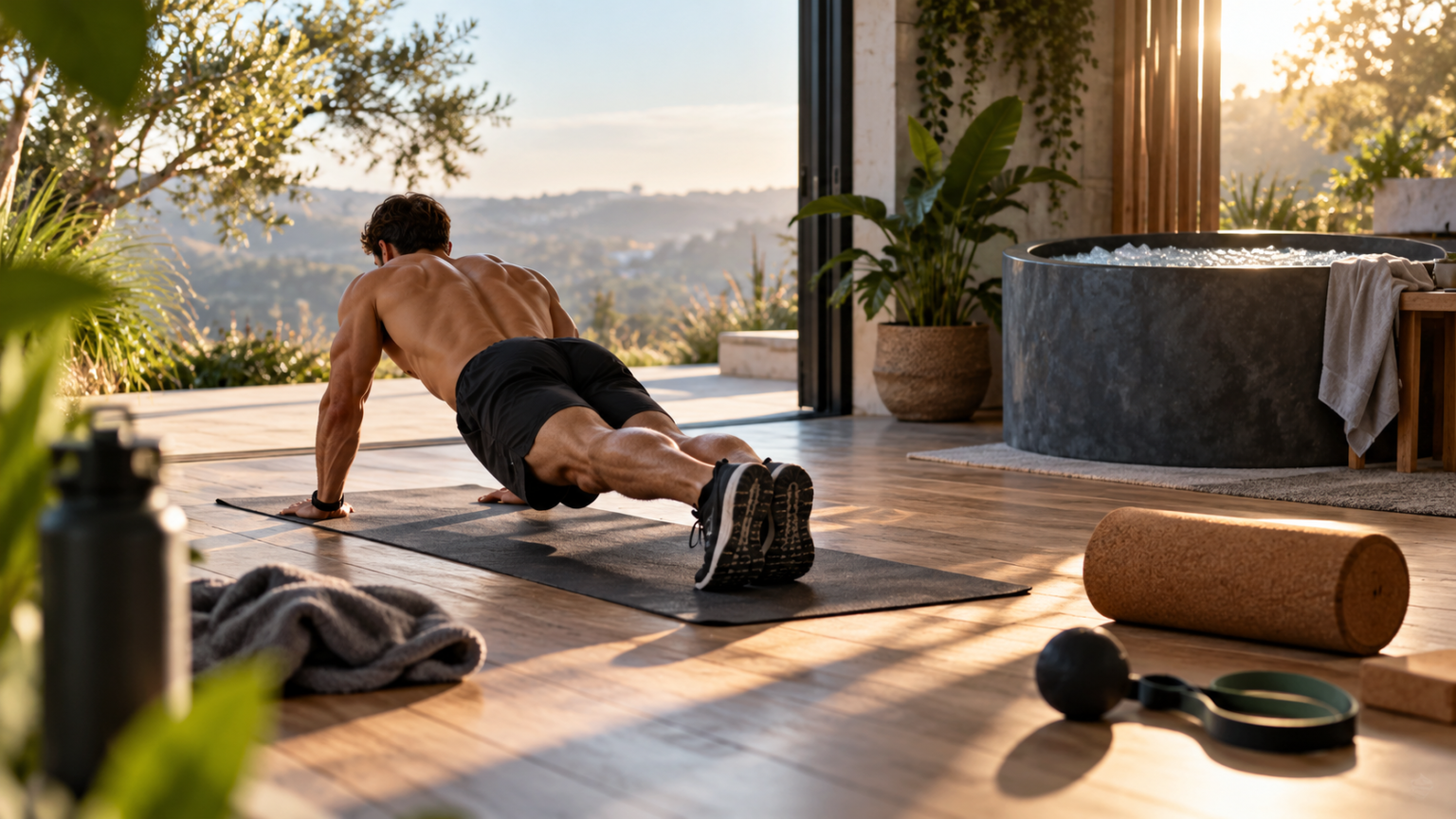
You do not need a weight bench or a full gym to train your chest effectively. With floor space, a wall, or a stable pair of household supports, you can build a home workout around push-up variations and other pressing movements. The best chest exercises without bench press at home are the ones you can perform with controlled technique, adapt to your current strength, and gradually make more challenging.
This guide explains how these exercises work, how to choose variations, and how to put them into a practical routine. It also covers common technique errors, ways to progress without heavy equipment, and safety considerations. Your chest muscles cannot be isolated completely during pressing: your shoulders, triceps, and trunk also help with the movements.
What does “chest exercises without a bench press” mean?
Chest exercises without a bench press are movements that train the pectoral muscles without using a barbell press performed on a weight bench. At home, the main options are body-weight pressing exercises, such as push-ups, and floor-based or standing variations that use resistance bands or dumbbells if available. A bench is not required for your chest to work against resistance.
The pectoralis major is the large, fan-shaped muscle across the front of the chest. The pectoralis minor lies beneath it. During a push-up, the pectoralis major helps bring the upper arm across the front of the body, while the triceps extend the elbows and the front shoulder muscles assist. Your abdominal and back muscles help keep your body stable. As a result, push-ups are compound exercises, not chest-only movements.
Exercise choice matters, but so do effort, range of motion, recovery, and gradual progression. A beginner may make progress with wall or incline push-ups, while a stronger trainee may need slower repetitions, a harder variation, a resistance band, or added load to keep a set challenging.
Best chest exercises without a bench at home
1. Wall push-up
Stand facing a wall and place your hands slightly wider than shoulder-width, around chest height. Step back until your arms are extended and your body forms a straight line from head to heels. Bend your elbows to bring your chest toward the wall, then press away. Keep your elbows at a comfortable angle rather than flaring them directly out to the sides.
Wall push-ups reduce the amount of body weight you press, so they can be a useful starting point for people who cannot yet perform a controlled floor push-up. Move your feet farther from the wall to increase difficulty, while keeping your stance and body position secure.
2. Incline push-up
Place your hands on a stable, non-slip surface such as a fixed kitchen counter or a sturdy, low platform. Walk your feet back and make a straight line from head to heels. Lower your chest toward the edge, then push back up. The higher the hand support, generally the easier the exercise; a lower support increases the challenge.
Check that the surface cannot slide, tip, or collapse before you begin. Avoid using wheeled furniture, loose boxes, or lightweight chairs. If you do not have a reliably stable support, use wall push-ups or kneeling push-ups instead.
3. Knee push-up
Start on your hands and knees, with your hands a little wider than your shoulders. Walk your hands forward enough that your body forms a straight line from your head to your knees. Brace your abdomen, bend your elbows, lower your chest under control, and press back up. Keep your hips from dropping toward the floor or folding back toward your heels.
Knee push-ups can help you practise the pressing pattern, but they do not perfectly replicate a full push-up because the body position and load differ. If you can do a few full repetitions with good control, include those too, even if you complete fewer repetitions per set.
4. Standard push-up
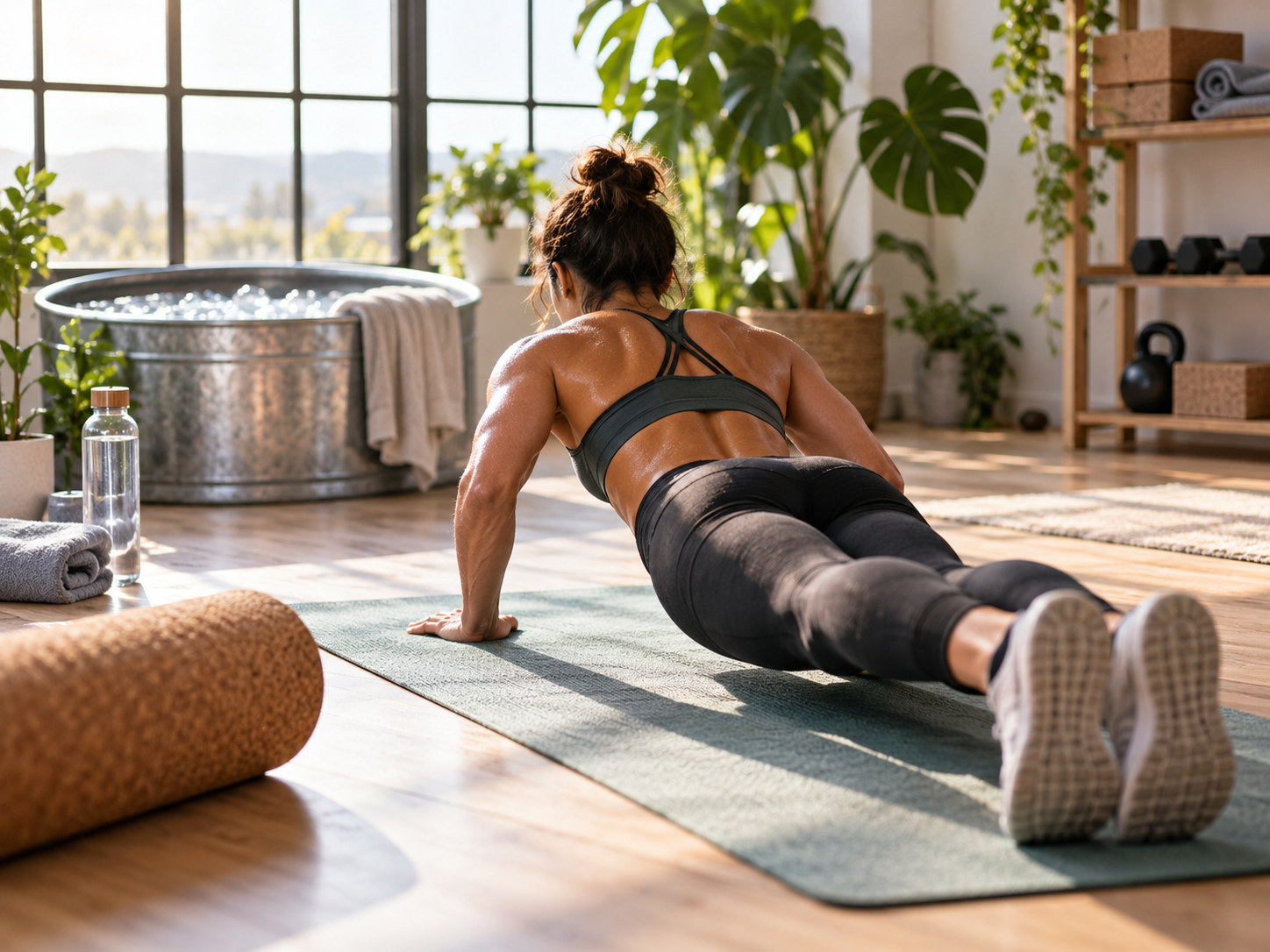
Begin in a high plank with hands just outside shoulder width and feet about hip-width apart. Tighten your trunk and glutes so your body stays in one line. Bend your elbows and lower your chest toward the floor while keeping your neck neutral. Press the floor away until your arms are extended without forcefully locking your elbows.
Use a range of motion that you can control without pain. A repetition is not better because it is faster or deeper; avoid letting your lower back sag, your hips pike upward, or your head reach forward. If your form breaks down, stop the set or switch to an incline version.
5. Close-grip push-up
Set up as for a standard push-up, but place your hands somewhat closer together. They do not have to touch. Lower with control, keeping your elbows near your sides as you press up. This variation often makes the triceps work harder, while the chest remains involved.
Do not force your hands into a very narrow position if that bothers your wrists or shoulders. A modestly closer hand position is enough to change the exercise. You can also perform it on an incline to reduce the load.
6. Wide-hand push-up
Place your hands slightly wider than for a standard push-up and perform the same controlled lowering and pressing motion. A wider position can change how the movement feels, but it is not necessary to place the hands extremely far apart. Very wide hand placement may be uncomfortable for some people and can make shoulder control more difficult.
Compare this variation with a standard push-up rather than assuming it targets a completely separate part of the chest. Hand position changes the movement, but no push-up variation can isolate one small area of the pectoral muscle.
7. Resistance-band chest press
If you own a resistance band, anchor it securely behind you at about chest height, following the band maker’s instructions. Hold one end in each hand, step forward to create manageable tension, and begin with your hands near your chest. Press forward until your arms are extended, then return slowly. Keep your feet stable and your trunk braced.
Inspect the band for cracks or damage and use only an anchor designed to hold it. Do not attach it to an unstable door handle or other fitting that could release. If the band or anchor does not feel secure, choose a body-weight exercise instead.
8. Floor dumbbell press, if you have weights
A floor press uses dumbbells while you lie on the floor, so no bench is needed. Hold the weights over your chest with a secure grip, arms extended but not forcefully locked. Lower them until your upper arms touch the floor gently, then press them back up. The floor limits how far the elbows can travel below the torso, which may feel comfortable for some people, though individual responses vary.
Use weights you can control, and make sure you can get into and out of position safely. Do not attempt a heavy lift alone if you cannot manage the weights securely. If you have no dumbbells, this exercise is optional; push-up variations can form the main workout.
How to build a practical home chest workout
A balanced routine does not need to include every variation in one session. Choose a difficulty level that lets you complete repetitions with steady form, and use enough rest to perform the next set safely. The following is a starting template, not a requirement or a medical prescription.
- Warm up for a few minutes. Walk briskly in place or do another easy whole-body movement, then practise a few gentle wall push-ups and shoulder circles. A warm-up should prepare you, not tire you out.
- Choose one main push-up variation. Try two or three sets of a manageable number of controlled repetitions. Stop with a little effort still in reserve rather than forcing repetitions after your technique fails.
- Add one complementary movement. Choose a close-grip push-up, incline push-up, band press, or floor press, depending on your equipment and comfort. Two or three sets can be enough to start.
- Rest between sets. Take enough time that you can perform the next set with control. Rest needs vary according to fitness, exercise difficulty, and the number of repetitions.
- Finish with easy movement and recovery. A relaxed walk or gentle shoulder and chest mobility may feel good. Stretching is optional; do not force a painful range.
For general strength training, the American College of Sports Medicine (ACSM) provides guidance on resistance exercise, including the value of training major muscle groups and adjusting exercise to a person’s goals and experience. The Centers for Disease Control and Prevention (CDC) also recommends muscle-strengthening activity as part of its broader physical activity guidance. These are general resources, not individualized plans for a particular injury or condition.
How to progress without a weight bench
Progression means gradually increasing the challenge as an exercise becomes more manageable. You do not need to chase a particular repetition count or make every workout harder. Instead, change one factor at a time and observe whether you can maintain good control.
- Reduce the incline: Move from a wall to a sturdy counter, then to a lower stable support, and eventually to the floor if appropriate.
- Improve control: Lower more slowly while keeping the movement smooth. Avoid turning the exercise into a long, uncomfortable hold.
- Add a set or repetitions: Increase volume gradually, not all at once. Stop if your form deteriorates or you develop pain.
- Use a harder variation: Once standard push-ups are comfortable, try a close-grip or other controlled variation. Advanced options are not necessary for everyone.
- Add suitable resistance: A band or dumbbell can increase the challenge, but only if the equipment and setup are secure.
Keep a simple training log with the exercise, variation, sets, and repetitions. This helps you notice whether a movement is becoming easier without relying on daily changes in how strong you feel. Progress is not always linear; sleep, stress, illness, and other training can affect a session.
Benefits and limitations
Potential benefits
- Convenience: Many variations require only floor space, making them suitable for home workouts and travel.
- Adjustable difficulty: Wall, incline, knee, and floor versions provide different ways to scale the movement.
- More than chest work: Pressing also challenges the triceps, shoulders, and muscles that stabilize the trunk.
- Low equipment cost: Body-weight options do not require a bench or barbell.
Limitations to keep in mind
- Loading can become difficult to adjust: Stronger trainees may eventually need bands, weights, or harder variations to keep increasing resistance.
- Push-ups involve other muscles: They train a pressing pattern but do not isolate the chest. A workout focused only on pushing may also neglect the back and legs.
- Home setups vary: Not every surface or piece of furniture is safe for incline exercise, and bands require a secure anchor.
- Results depend on more than exercise selection: Consistent training, adequate food and hydration, sleep, and recovery all matter. No single movement guarantees a particular appearance or strength outcome.
For overall strength and movement balance, consider training your back, legs, and other muscle groups too. A home routine can include rows with suitable equipment, squats, hinges, and other exercises that fit your space and ability. Running or other cardio can complement strength training, but it does not replace resistance work for the muscles.
Form, pain, and injury prevention
Muscle effort and mild fatigue during exercise can be normal; sharp, worsening, or unusual pain is a reason to stop. Do not push through joint pain, numbness, dizziness, or symptoms that concern you. Check your hand position, reduce the range, or use an easier variation, but do not assume that technique changes will resolve an injury.
Keep your wrists comfortable by spreading your fingers and placing your hands securely. If floor push-ups bother your wrists, an incline may feel better, but individual needs differ. Do not use unstable objects to raise your hands. Maintain a controlled pace, breathe continuously, and avoid holding your breath through difficult repetitions.
People with a current injury, recent surgery, persistent shoulder or wrist symptoms, or a health condition affecting exercise should seek advice from a qualified clinician before starting or changing a program. Rest and recovery are part of training: allow time between challenging sessions, and reduce training if fatigue or soreness keeps worsening.
Q&A
Can I build my chest at home without dumbbells?
Yes. Push-up variations provide a way to train pressing with body weight. Begin with a version you can perform with control and gradually adjust the difficulty. Equipment can add options, but it is not essential for starting.
Which push-up is best for beginners?
There is no single best version for everyone. Wall or incline push-ups are useful starting points when floor push-ups are too difficult. Choose a height that allows controlled repetitions without pain or loss of body position.
Do wide push-ups target the outer chest?
Claims that a particular hand width isolates a distinct outer-chest area are oversimplified. Hand position changes the movement and how it feels, but push-ups still involve multiple muscles. Use a comfortable width and train through a controlled range.
How often should I train chest?
Frequency depends on your overall program, recovery, experience, and health. Avoid training hard through persistent soreness or pain. If you are unsure how to fit chest work into a broader routine, consult a qualified fitness professional.
Do I need to stretch after push-ups?
No specific stretch is required for everyone. Gentle mobility can be comfortable, but stretching should not be forced or painful. General recovery also includes rest, sleep, and enough food and fluids for your activity level.
Takeaway
The best chest exercises without bench press at home are practical, safe-to-set-up movements that match your current ability: wall and incline push-ups for an easier start, standard and close-grip push-ups for more challenge, and band or floor presses if you have suitable equipment. Focus on controlled technique, progress gradually, and include other muscle groups in your overall training. Exercise guidance is general information, not a diagnosis or a substitute for individualized medical advice.