





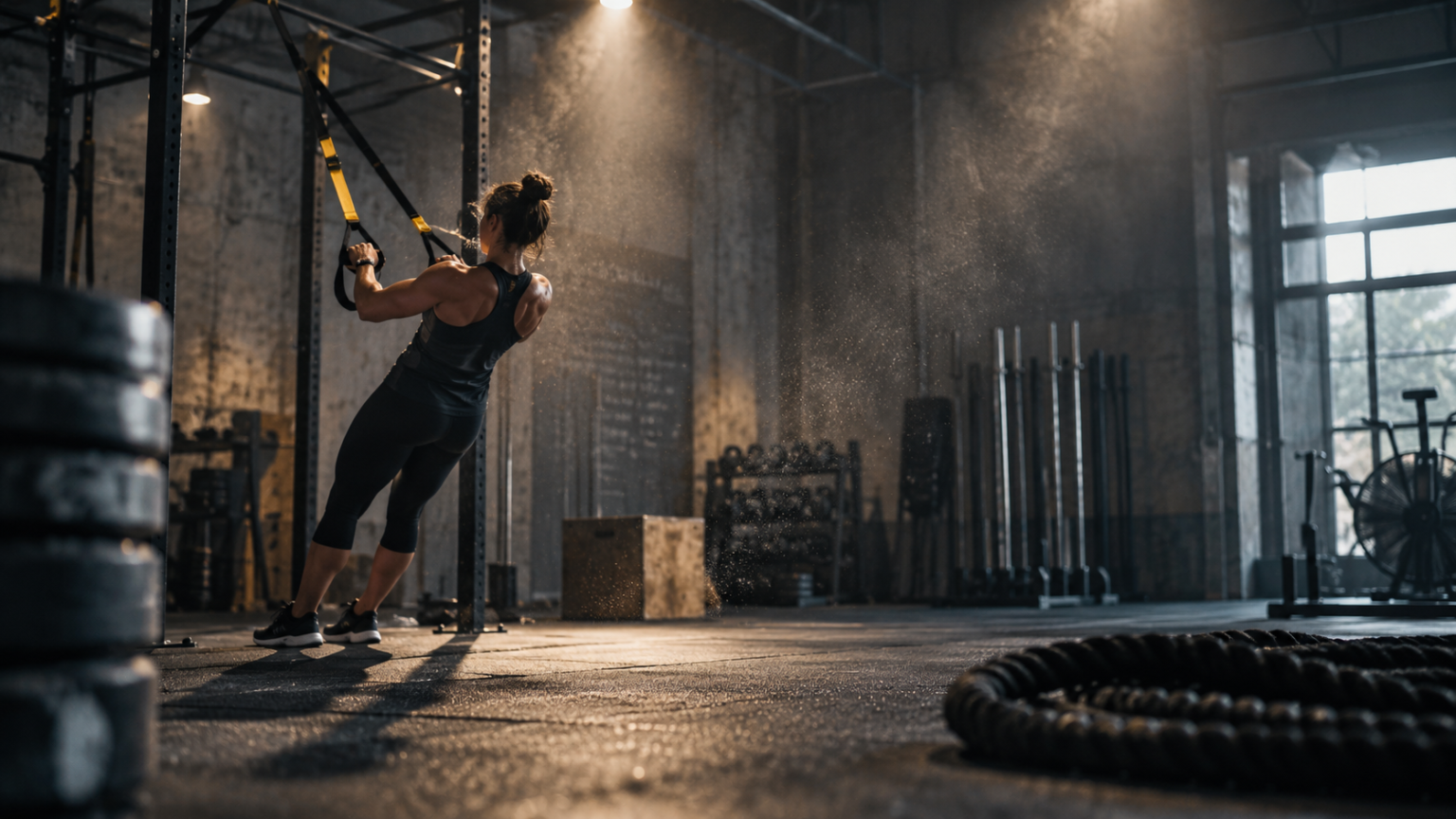
The best suspension trainer TRX exercises for full body training are not necessarily the hardest variations. They are the movements you can perform with control, adjust to your ability, and combine to train the major movement patterns: pushing, pulling, squatting, hinging, and bracing. A suspension trainer uses adjustable straps and your body weight, so changing your position changes how demanding many exercises feel.
This guide explains what suspension training is, how to set up a balanced full-body session, and how to adjust exercises for strength, conditioning, and mobility. The suggestions are based on exercise instructions and movement principles, not on a product comparison or personal testing. For exercise references, consult TRX Training’s official exercise library and the American Council on Exercise (ACE) exercise library. They provide named exercise demonstrations and technique guidance; the workout below organizes common suspension movements by movement pattern rather than claiming one exercise is universally best.
What Is Suspension Training?
Suspension training is resistance exercise performed with handles attached to adjustable straps and an anchor point. Your hands or feet connect to the handles, while the rest of your body is supported by the floor or held at an angle. Because the straps move freely, many exercises require you to control your body position as well as produce force.
Difficulty is usually adjusted by changing body angle, stance, range of motion, or support. For example, standing more upright during a row generally makes it easier than leaning farther back. The exact challenge also depends on the exercise, your proportions, strength, balance, and how securely the trainer is set up. Suspension training can support strength work and higher-tempo circuits, but it does not automatically replace every form of resistance training. External weights may be more practical when you need small, measurable load increases or heavy loading.
How to Choose the Best Full-Body Exercises
A useful session covers the whole body without relying on a long list of similar movements. Choose exercises that train complementary actions: a squat or lunge for the legs, a hip hinge for the posterior chain, a row and a press for the upper body, and a bracing exercise for the trunk. Single-leg work and controlled balance challenges can add coordination, but they should not replace basic strength practice if your technique is still developing.
Use the following criteria when selecting exercises:
- Clear purpose: Each movement should have a role in the session, such as pulling, pushing, or training leg strength.
- Manageable technique: You should be able to keep a steady body position and control the return portion of each repetition.
- Adjustable challenge: You can make the exercise easier or harder without losing control of the straps or your alignment.
- Suitable range: Work through a comfortable range that does not provoke sharp pain or force a joint into an uncomfortable position.
Do not treat instability as a goal in itself. More wobbling does not necessarily mean a better strength exercise. When balance becomes the limiting factor, use a more upright angle, a wider stance, or a simpler variation so the intended muscles can do the work.
Best Suspension Trainer TRX Exercises for Full Body
The exercises below form a menu, not a mandatory circuit. Start with a few that match your training experience and available time. Check the trainer’s manual for anchor requirements, strap adjustment, and any model-specific setup instructions.
1. Suspension Squat
Hold the handles in front of you and step back enough to keep light tension in the straps. Sit your hips down and back while bending your knees, then stand by pressing through your feet. The handles can provide balance assistance, but avoid pulling yourself upward with your arms. Keep your knees tracking in the same general direction as your toes and use a depth you can control.
This is a useful entry-level leg exercise because the straps can help you balance. To make it more demanding, reduce how much you rely on the handles or use a split-stance variation. If you feel knee discomfort, shorten the range and reassess your stance. Persistent or sharp pain calls for stopping rather than pushing through.
2. Suspension Row
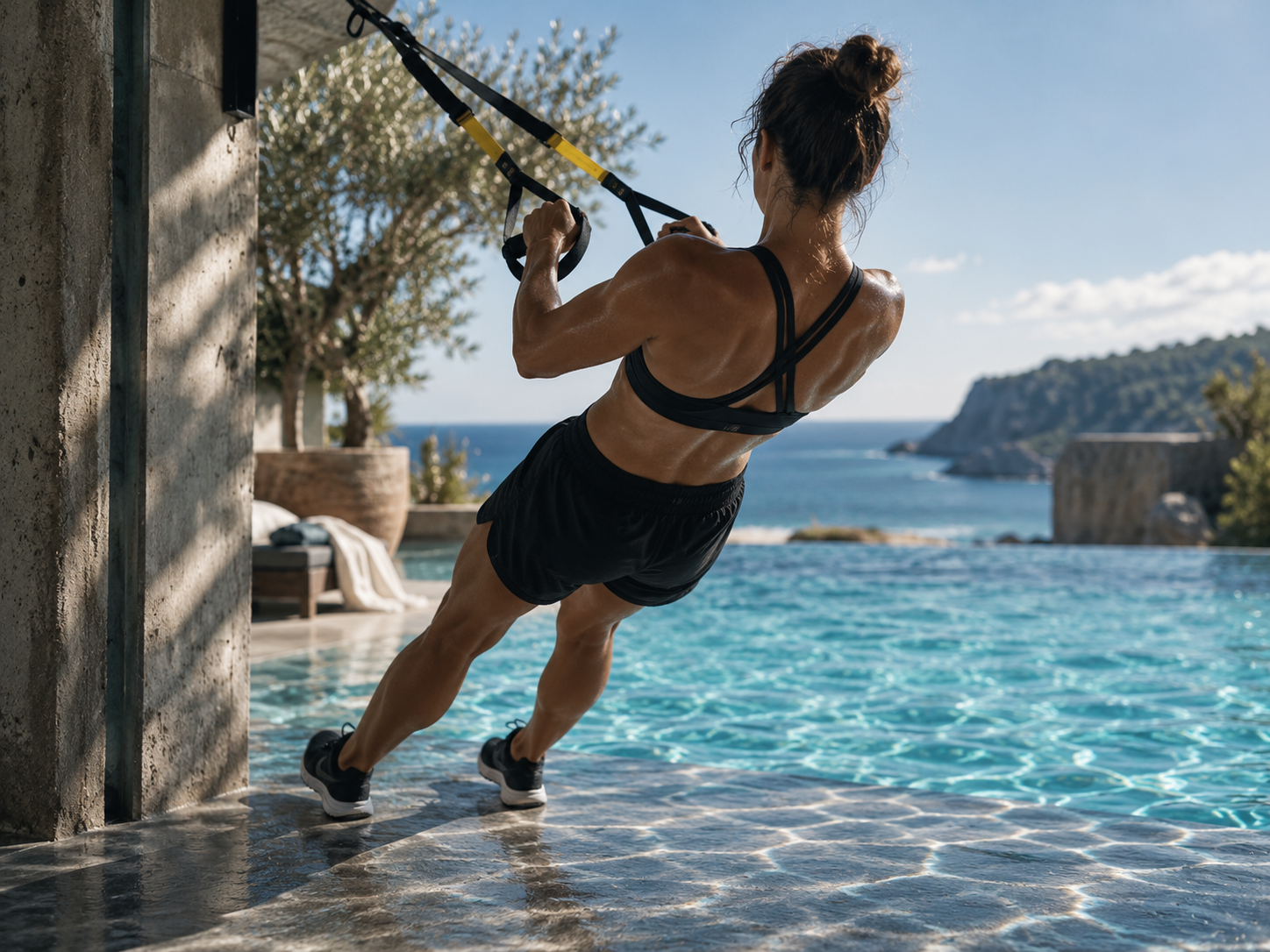
Face the anchor, hold the handles, and lean back with your body in a straight line. Draw your elbows behind you and bring your chest toward your hands, then lower under control. Keep your shoulders away from your ears and avoid letting your hips sag. A more upright body position reduces the challenge; a more horizontal position increases it.
The row trains upper-body pulling and can complement push-ups, which emphasize pushing. Begin with a position that allows smooth repetitions. Do not jerk the straps or turn the movement into a hip thrust to finish a rep.
3. Suspension Chest Press
Stand facing away from the anchor, handles near your chest, and lean forward with your body aligned. Bend your elbows to lower your chest between the handles, then press back to the start. Keep the straps clear of your arms, your ribs controlled, and your head in line with your torso. Step closer to upright to reduce the challenge.
Choose a range that feels comfortable for your shoulders. If your shoulders roll forward or your lower back arches to complete the press, make the angle easier. A floor push-up or wall push-up can be an alternative while you build control.
4. Suspension Hamstring Curl
Set the foot cradles so your heels can rest in them, then lie on your back with your legs extended. Lift your hips only as high as you can maintain a stable trunk. Bend your knees to draw your heels toward you, then extend your legs slowly. Keep the movement controlled instead of allowing the straps to pull your feet away.
This exercise trains the hamstrings through knee flexion while the hips stay lifted. It can be demanding even for experienced trainees. Start with a small range or perform fewer repetitions if you cannot maintain hip position. Stop if the foot cradles feel unstable or your lower back becomes uncomfortable.
5. Reverse Lunge
Face the anchor and hold the handles lightly. Step one foot back into a lunge, bending both knees as far as comfortable, then return to standing. Keep most of your effort in the working leg rather than leaning heavily on the straps. Train both sides and use a shorter step or shallower depth if balance or mobility limits your form.
Reverse lunges train each leg separately and can help reveal side-to-side differences. They do not diagnose a problem, and a difference in performance is not by itself a reason to assume injury. If one side causes pain, use a comfortable alternative and seek qualified advice when symptoms persist.
6. Hip Hinge or Assisted Single-Leg Hinge
Face the anchor and hold the handles as a light balance aid. Soften your knees, push your hips back, and let your torso tip forward while keeping your back in a comfortable neutral position. Return to standing by bringing your hips forward. For a single-leg version, shift your weight to one foot and reach the other leg behind you, using the straps only as needed for balance.
The hinge pattern trains the hips and posterior chain. Keep the range modest at first; reaching farther is not useful if your back rounds or your balance breaks down. A two-leg hinge is the better starting point for many people.
7. Suspension Plank
Place your feet in the cradles and set your hands or forearms on the floor, depending on the variation. Arrange your body in a straight line from shoulders through hips to ankles, then brace gently as if preparing for a light nudge. Hold while breathing normally. Begin with a short hold or put your feet on the floor if the suspended version is too difficult.
Suspended planks can challenge trunk control, but they are not necessary for building a strong core. A stable floor plank is a sensible regression. End the set when your hips sag, your back position changes, or you cannot breathe comfortably.
A Practical Full-Body Session
For a general session, select one squat or lunge, one hinge or hamstring exercise, one row, one press, and one trunk exercise. Warm up with several minutes of easy movement, such as brisk walking or gentle mobility work, followed by lighter practice repetitions of the planned exercises. The warm-up should prepare you, not tire you out.
- Suspension squat: 2 to 3 sets of 8 to 12 controlled repetitions.
- Suspension row: 2 to 3 sets of 8 to 12 repetitions.
- Chest press: 2 to 3 sets of 6 to 12 repetitions.
- Reverse lunge: 2 sets of 6 to 10 repetitions per side.
- Hamstring curl or hip hinge: 2 sets of 8 to 12 repetitions.
- Plank: 2 to 3 holds of about 15 to 30 seconds, stopping earlier if your position changes.
These ranges are practical starting points, not a prescription or a guarantee of results. Rest long enough to repeat good-quality work; for many people, that means roughly one to two minutes, with more rest if breathing or technique has not recovered. If you are new to resistance training, start with fewer sets and leave several repetitions in reserve. When all sets feel controlled, progress one variable at a time: slightly increase repetitions, adjust your angle, add a set, or select a harder variation. Avoid changing every variable at once.
Using Suspension Training Alongside Other Fitness Goals
For strength training, prioritize consistent technique and gradually make the work more challenging. A strap-based circuit can also raise your heart rate, but cardio fitness is better planned around your overall training needs. Walking, running, cycling, or other aerobic exercise may be easier to dose and sustain. If you run, place demanding leg sessions so they do not undermine key running workouts or recovery.
Home workouts benefit from simple scheduling: set up the anchor before starting, keep the exercise order consistent, and record the angle or variation you used. That makes progress easier to judge than relying on how difficult a session felt. If you practise yoga or flexibility work, use it for mobility and relaxation as appropriate, not as a substitute for progressive strength work. Athletes should also consider adequate food, hydration, sleep, and recovery; no single suspension routine can compensate for poor recovery habits.
For injury prevention, no exercise can promise that injuries will not happen. A balanced program, gradual changes in training load, appropriate technique, and attention to symptoms are more defensible goals. Sports psychology can also matter: setting a manageable session target and focusing on one technique cue at a time can make training easier to follow, but mental skills do not replace medical care or sound programming.
Pros and Cons
Advantages
- One adjustable trainer supports a variety of upper-body, lower-body, and trunk exercises.
- Body angle and stance provide accessible ways to modify many movements.
- The equipment can be practical for home workouts when a suitable anchor is available.
- Exercises can train coordination and body control alongside muscular effort.
Limitations
- Secure setup is essential; not every door, beam, or outdoor structure is an appropriate anchor.
- Straps can move during exercises, which may make some movements harder to learn or control.
- Progressive loading can be less precise than adding known increments of weight.
- Foot-cradle exercises may be uncomfortable or impractical for some users.
- Training alone with straps does not ensure a balanced program or correct technique.
Q&A
Can a suspension trainer provide a full-body workout?
Yes. A session that includes leg, hip, push, pull, and trunk patterns can train the whole body. Whether it is sufficient for a particular goal depends on exercise selection, effort, progression, and how it fits into your wider program.
How often should I do a TRX workout?
Frequency depends on your experience, intensity, and other training. Leave enough time to recover before repeating hard work for the same muscles. If you also run, lift weights, or play sports, count those sessions when planning your week.
Are suspension exercises suitable for beginners?
Many have easier variations, such as a more upright row or assisted squat. Start with a stable anchor and simple movements, and consider qualified instruction if you are unsure about setup or technique.
Can suspension training improve flexibility?
Some movements use a comfortable range of motion, but suspension training is primarily a resistance-training method. Use dedicated mobility or flexibility work if those are specific goals, and avoid forcing stretches or exercise ranges that cause pain.
Safety and Scope
Inspect the trainer and anchor before each session, follow the manufacturer’s setup instructions, and keep the area clear. Do not use a damaged strap or an anchor that shifts, and do not assume a door or overhead fixture can support dynamic exercise. Stop if you experience sharp pain, dizziness, unusual shortness of breath, or other concerning symptoms. This article provides general fitness information, not medical diagnosis or individualized coaching. People with an injury, relevant health condition, pregnancy-related concerns, or uncertainty about exercise suitability should consult a qualified healthcare professional before training.